Showing posts with label story drama. Show all posts

Wednesday, April 17, 2019

Get Outside And Play with Loose Parts: The Pesach Edition!

Pesach is ever so near and it is a holiday laden with opportunities for play and learning for children. S has been busy crafting, learning, storytelling, reading, building, tasting and singing at school. Y has been working on his own Hagadah with me at home. Their free play at home has been infused with Pesach themes and one afternoon last week, I decided to roll with that in an "out-of-the-box" and outdoors way--playing about Pesach with loose parts.

There are plenty of loose parts purists out there--folks who use only the strictest adherence to loose parts play theory in their classrooms and homes. These spaces can be amazing for children and adults of all ages. I am more eclectic here. I like to add it in, like a nutritional supplement, as opposed to rigidly adhering (like a restrictive diet). One challenge I often have with loose parts play indoors is the restriction of space. We make it work and have done some amazing play and exploration with a variety of different loose parts. Heading outside allows us a bit more space (particularly in our backyard space, even though, like our front yard it is semi-public and shared with neighbors) and a novel backdrop. One in which the environment itself can serve as a loose part (or multiple loose parts).
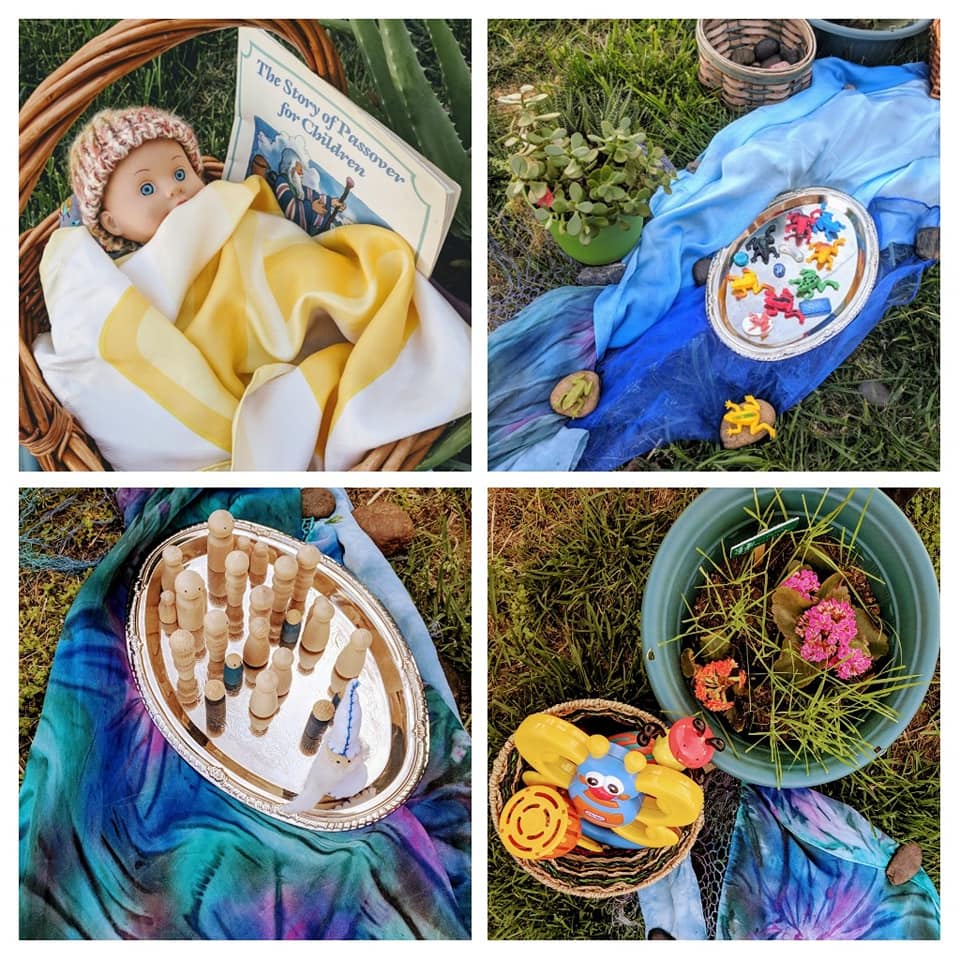
In setting up our provocation, I wanted to include the Pesach story and elements for retelling it. I also wanted to incorporate items large and small, natural and man-made, living and nonliving, some even musical! There was a basket with a baby Moshe and a picture book with the Pesach story. There was a basket full of play silks and scarves. Perhaps the boys would dress up or add them to the scene. Silks laid across the ground to resemble the river were lined with rocks (and a basket of those were set along the side as well) and plants. There was a tray of frogs and glass gems (gotta throw in your favorite plague), and a small dish of glass gems and mosaic tiles and interesting stones as well. Another metal tray held our fearless leader, Moshe Rabeinu, and a selection of wooden peg dolls representing the Jewish people behind him on their journey out of Mitzrayim. The end of the Nile was marked with a basket of tambourines played by Miriam and the Jewish women and along the sides were some baskets of cardboard tubes and assorted window blocks. Beyond that were the items already out in our backyard space.
I gave very little introduction other than to say there were toys and materials for playing about the story of Pesach. The boys could use what they wished as they felt they wanted to. They could act out the story, play about it, build about it or come up with their own ideas.

Many times, when something is new, it is met with a bit of trepidation. Some children will flock toward the familiar. Some will dip their pinky toe in and then slowly enter. Others jump in, full body and immerse. Still others will go to another space or activity altogether and enter only when ready. This is why I always remind myself and others of the most important "loose part," TIME. Children need time to engage, immerse and remain in creative play. We tend to pour a lot of energy and time ourselves into provocations or activity setups and then we can feel frustrated or concerned when they are not met with a response we expected. One thing I have almost always found to be true is that given the space of time and silence, children do engage and explore--each in their own way and at their own pace.
Y went immediately to the baby Moshe in the basket. He loves babies right now and this felt familiar and soothing.
S gave everything the once over and walked away to the sensory bin, still filled with desert sand dough from our Digging in the Desert STEM challenge. A repeated activity has the component of familiarity that is comforting to him and served as a base for later emerging into the play scene across the yard... Sand, dough and sensory materials are a wonderful loose part to use in play! He also enjoys using other loose parts and tools in the sensory table, taking them out into other play areas and adding in others from other play areas as well. 
Both boys slowly moved into their play experience and I really invited myself to sit back and observe. At one point, I asked S and Y if they would like me to read the story in the book while they played. S's response was incredible! "Mommy, I'm worried that if you are reading it will stop us from playing!" I love that he advocated for ownership in his play space and experience. I completely respected his response and continued to watch as they played, responding to questions or remarks as I was invited to.


Play begets play and sometimes there are requests for additional components to support the process, like when S asked if I could build the tee-pee for them again. We stopped into the house to grab our old sheet and I re-planted the garden stakes and fastened on the sheet for the boys. He busily took to building a bonfire again using silks and stones and then needed to go to the front yard to pick a couple of sticks from our play garden. That, of course, meant he'd need some playdough from our STEAM drawer cart inside to make them marshmallows for roasting. Perhaps the part about roasting marshmallows over a bonfire during the original exodus from Egypt didn't make the story line in our liturgy, but it did in play!


 Large riding toys, push toys and other outdoor materials make for great loose parts as well. Here, S lay himself in our big red wagon and declared that he was "baby Moshe in his basket."

It took the boys a while to fully engage in our provocation and they were completely immersed for quite a while as well. Long enough for Tatty to get home and make the grown-ups some dinner which we happily ate up outside watching the boys in wonder and play.


Once two, somewhat reluctant but very tired boys were hauled up for a bath and bedtime, I decided to set up a smaller scale Pesach provocation on our kids' table. This would greet them in the morning and kept them busy throughout the weekend that followed. While they start at the table, the pieces rarely remain there. Some are incorporated into block buildings. Some find their way to other areas or other uses and part of encouraging the boys to engage in this type of play is allowing for that (and working on skills to return objects appropriately when we are done). One of the best components of encouraging loose parts play before a big holiday is the fact that it is so independently led and run by the children. We can get a lot done while they are engaged in their play. There's still a lot to do to prepare for the holiday but for now, everyone is keeping pleasantly busy (most of the time) and, as always, happily playing!

Wednesday, February 13, 2019

A Peek Inside Our Playroom: Welcome to Fairy Tale Land!

There has been a great deal of building excitement over Purim this year with the beginning of the new Jewish month of Adar. The challenge this year is that it is a leap year in the Jewish calendar and there are two months of Adar--this is Adar I. Purim falls in Adar II. Conversations with S have been flooded with the topic of costumes, the Purim story and characters, and, of course, the treats we eat and share on the holiday. Even Y has been toddling around claiming to be Haman with a very believable scowl on his face! So do I try to quell the excitement and shift the focus for the next several weeks? At first, I did. I didn't want it to be "too hard to wait." But then (even I was getting excited by now) I wondered, why is it so terrible to be excited while you wait? Excitement is a wonderful and joyful emotion. And the month(s) of Adar are a time we are called upon to increase joy. So, I told the boys a few days ago that we would do a playroom shift and transform our Fire Station into a Fairy Tale Land!


The boys used watercolor paints in a crayon resist
to decorate our play-theme signs.
The Purim story itself is quite a dramatic one--most suitable for acting, story telling and small world play. It lends itself quite well to a fairy tale theme. I've touched upon the topic of fairy tales with young children before and I do think they hold an inherent value educationally as well as socially and emotionally for children. I do not feel concerned that children won't recognize the difference between fact and fiction. I don't worry about some of the darker content in fairy tales either--literature and play are safe spaces to navigate deep emotions and childhood fears. I do think that fairy tales are rich in language and opportunities to problem solve, think critically and resolve conflict. Through playing and story telling about common fairy tales and fairy tale themes, children gain an empowering role in overcoming childhood challenges as well as a rich vocabulary, deep imagination, creativity, social skills and critical thinking skills to boot.

While I have prepared materials for many of our dramatic play themes, this one I created from scratch. I spread the work over the course of many days in advance and even I was getting too excited to wait until Purim was closer to transform our play space. I am holding off on setting out all of our Purim props and accessories, but I knew I wanted our Fairy Tale Land play-theme to include some key components:

  • costumes (both specific character costumes as well as open ended props and playsilks)
  • puppets and our puppet theater
  • a Three Bears' Cafe in our kitchen/housekeeping area (the boys had been playing about restaurants a lot lately)
  • small world play opportunities
  • castle building opportunities with a variety of blocks and loose parts
  • literature!
  • theme related sensory play
  • theme related STEAM challenges
  • art
  • creative writing/recording, story telling and play acting
I will definitely be posting as we delve deeper into this theme, exploring individual fairy tales in a variety of ways as well as incorporating creative STEAM activities, sensory bins and art/creative writing opportunities. Until then, here's a peek in side our playroom...
A collection of hand puppets and finger puppets are ready to go along with our puppet theater. The boys can put on their own impromptu shows (we even have show tickets!) or act out specific stories and fairy tales. 
Castles and building castles are a big component of this theme. We brought out a wooden playcastle I bought last year at a craft supply store and some toy "Purim story characters" (medieval dolls from Safari Ltd.) and also generic dollhouse dolls and furniture. I also included larger building materials in this area (a combination of recycled tubes and magnetiles) to encourage building on to the castle and kingdom. The boys can bring in other toys and building materials from our other shelves and STEAM cart as they wish. 


Costume central! We have baskets of scarves/playsilks, hats, costumes and costume props.

The Three Bear's Cafe can extend into our living room kids table to accommodate restaurant patrons (human or puppet!) 

Our menu, with a bit of my sense of humor and a photo bomb by a particular Ninja Turtle...

Our play shelves and STEAM cart are stocked and ready. The boys really like to have space beyond the kitchen set for setting up cooking/baking activities, restaurants and stores. I devoted two shelves to that purpose. The top shelf has some additional building materials and loose parts, peg dolls and props for small world play. 

I kept some of the drawers in our STEAM cart the same--particularly ones that were getting a lot of traffic from the boys (like our woodworking drawer and scrap wood). I swapped in bear counters in three sizes (perfect for Goldilocks!), some photos of real castles to inspire building ideas and writing/recording ideas, some awesome castle blocks I scored at a thrift store last year (pictured above) as well as Legos and colored wooden blocks.

Our current sensory table is a Porridge Sensory Bin to go along with our Three Bears' Cafe...very simple setup with dried oats and some cooking utensils and wooden dishes.

The boys got busy at play!

Dinner entertainment has been amazing around here...

Parenting hack: Hang mirrors outside of your bathrooms! Your kids will spend all day looking at themselves and you can finally reclaim the right to peeing alone with the door closed!
Happy Playing!

Thursday, February 7, 2019

Beyond the Book (and Off to the Park) with Denise Fleming's "Time to Sleep"


We were not spared by last week's polar vortex and temperatures here dropped below freezing for several days in a row. It was the perfect time to be learning about winter and animals' behavior during that time--we all felt like hibernating here! S has been delving into these topics in school and I planned that this week we would delve back into some of our Winter Story Stretchers at home.

So, of course temperatures have risen from a frigid low of 17 degrees last Tuesday to a high this past Tuesday of 71! It was the perfect afternoon to go to a favorite park nearby where they recently remodeled the playground equipment. (I actually took Y on Monday to test drive the new slides while S was at school but we didn't tell him...shhhh!) I knew the park would be packed and crowded and that there was only about an hour left of daylight once we would get there. I also knew that very likely the boys would be more interested in the playground equipment than sitting down to a book together, but nonetheless, I packed my bag with Time to Sleep, a beautifully illustrated book about animals preparing for winter hibernation by Denise Fleming, a basket of animal characters and a couple more empty baskets we saved from a family trip to a U-Pick berry farm over the summer.

I'm big on literacy at home and in the classroom. However, I'm bigger on love of literacy than any other area of its development in young children. Reading together doesn't need to be a sedentary, indoor activity in my home (or in my classrooms). Taking books outdoors is a great way to extend the life and setting of a good story! It's also often challenging to get outdoors with our children in the winter months, and while we definitely stayed mostly inside during last week's polar vortex, it feels very important to soak up every bit of sun when we can be outside together. We can teach about winter and animals in winter through direct instruction indoors, but when we take the lesson outside, children can experience and explore the season in action and through all senses and learning styles.

We started our park visit at a picnic table, enjoying a little dinner and S actually asked to read our book. Y was feeling a bit more eager to try a swing, so you know what? I stopped reading in the middle of the book! And that's OK! I have actual memories of playing school as a child and reading a book aloud to my imaginary students when I would realize the book was too challenging for my current reading level or that I was bored of reading it and I would struggle as I put it down with the internal question of whether it was ever OK for a teacher to not finish a book. Furthermore, was it ever OK for a person to put a book down and not read it from cover to cover? I am here today as a fully literate and recovered reluctant reader who has a passion for early literacy to tell you--YES, it is OK to put a book down. Even when you are teaching. Even when you are a parent. Even for yourself. Whether or not you pick it up again later, the next day or never again. It is OK to put a book down.
S found seed pods, acorns (many of them emptied
by something or someone snacking before winter,
even dried corn kernels on the ground, and of course,
many interesting sticks--his current currency of choice.

At first, S wanted to use some items from nature and spaces near the playground to build dens for our animal toys and puppets to hibernate in. Then he saw the new climbing structure and our animals were restored to their cozy basket and hung from the hook on the handle of our double stroller to watch as the boys played, climbed, ran and slid for the final moments of daylight. Then, I did a sneaky parenting type of thing as it was time to go where I trick the kids into doing something slightly educational and lots of fun. I offered, as it was time to go, to go the "short way right to the car" or the "long way, around the pond to walk and gather nuts and seed pods and other treasures in our gathering baskets and pretend the we are going to hibernate!" (See what I did there? Guess which option they picked? Which would you pick?)

Nature walks like this are so valuable in so many ways. We work on skills like observation--where might an animal look for food to gather for winter? How might an animal move about to find things? We talk about the idea of gathering things from nature--leaving what is still alive and growing in a way that we found it, taking only small amounts of treasure for ourselves and leaving the rest of nature in nature (and not taking anything from areas that are under preservation restrictions or private property). We also work on basic safety skills like staying together, being aware of our surroundings and proximity to water or dogs and pedestrians or surface changes.
As a parent of young children, I find it is easiest to keep my boys buckled in our double stroller as we stroll around the pond. I know where they are, no one is running up ahead, there's no danger of falling into a body of still very cold pond water! Those fears grow in size with Y, who has a very different attitude about walking independently in public places than S did at that age. I remember practicing staying together in this park with S and he was so eager to listen when I would say or sing the directions to stop and wait. Y....not so much! He is a young man with a mission. The mission is always evolving. He is also a young man with a visual delay and low vision. Although he has glasses to support this, using his eyes as a resource is not his first mode of navigating the world around him. And he's busy. And fast. At least once a day, I am muttering the words "remind me to thank his physical therapist" through clenched teeth as he ascends to new heights and darts off to new distances... It takes so much energy and focus for me to refrain from constantly uttering the words "be careful!" I want him to observe and navigate his space with confidence. I also want him to be safe. I try to verbalize this in ways that encourage him to observe his surroundings while also maintaining a healthy level of cautious confidence.
For some little ones learning to navigate large outdoor or public spaces more independently, having something to hold and focus on like a gathering basket can be very helpful. Y preferred to abandon the basket and bask in the sunset. We both had a great opportunity to work together on staying together at the park last night and rather than avoiding these scenarios, I will intentionally be pursuing them continually with him (and perhaps toting along a soothing travel mug of tea for myself...)
Y was quite fond of the snail in the book, insistent
upon wearing the finger puppet for most of the
evening. S and I were so amazed to learn that
snails seal up their shells for winter hibernation!
Learning about winter and animals in winter can be such an exciting way to actively embrace a season that is often thought of as barren and dormant. There are definitely barriers this time of year, whether you live in a climate prone to winter weather and especially if you live in one not prone to winter weather. Nonetheless, getting outside and reading--and playing--together is a great way to fight off those seasonal blues and soak up the learning and vitamin D while you're at it. My original plan with this book was to gather the toy animals indoors and pitch our play tent and allow the boys to build dens, nests and sleeping spots for each one and maybe for themselves. I'm so glad that some unexpected sunny days led us outdoors instead, story and story basket in tow. We've left our target book out in our living room library shelf and the story basket set in front. Story drama through the use of small toys, puppets or play acting is a great way for children to expand on what they have learned through reenacting story sequences or adding on their own elements.


If you'd like to expand upon this particular story stretcher, a teacher friend of mine did a beautiful STEM setup using toy animals from the book and a collection of natural and nature-based loose parts for her students to build dens for the animals to hibernate. It's also a great book to use alongside this simple clay sensory bin and play about animals in winter. We've mixed in forest and arctic animals, but you can choose one or the other, or specifically the animals in the book. The clay becomes a perfect medium for observing animal tracks as well as for constructing dens, caves, nests or even igloos.

I hope this leaves you with a bit of whimsy and inspiration. Whether you're indoors and avoiding an arctic chill or outside soaking up unseasonable summer temperatures in the middle of winter, it's the perfect season for reading together and, as always, happily playing!


Monday, December 31, 2018

Winter Story Stretcher: "The Story of the Snow Children" by Sibylle von Olfers

The wondrous world that exists in Sibylle von Olfers' children's books may be teeny tiny, but they truly stretch the imagination to new heights. S and Y still frequently ask to hear The Story of the Root Children before bedtime and this winter, I was eager to add The Story of the Snow Children to our collection. These whimsical tales naturally lend themselves to storytelling and play acting, so I knew that this would be an integral part of this story stretcher in our Winter Break Story Stretchers Playcamp. \

I introduced our book and a simple craft to decorate winter crowns for our Morning Work activity the day before we were to do our story stretcher. We used snowflake stickers and glitter crayons to decorate our crowns as we would be playing the part of guests at the royal feast of the Snow Queen and her little Princess on her birthday. I love setting out a small world display to introduce our book and morning activity. I used our peg doll family and a collection of peg doll snowmen pulling them on a tiny sled. The boys enjoyed playing with that as much as making their crowns.

When it was time to start our story stretcher, the boys were greeted on the rug with a welcoming song and our own makeshift sleigh. But before it was time to board, we danced around the room like the snow children do in the book and bundled up in warm clothes like Poppy, the main character, just as she is about to embark on her wintry adventure. Our sleigh took us to the table where our own royal feast was ready to be served: iced tea (as in the book) and "snow snacks" (Muddy Buddies I prepared in advance from this recipe since we did not have white chocolate as mentioned in the book). The boys loved having iced tea poured from our fanciest tea pot!


As the boys sipped and snacked, I finished reading the book. S and Y donned their winter crowns for the royal dancing around our living room...


S really wanted to act out the story again from the beginning! I told him he can retell it and act it out as many times as he'd like! That's the wonderful thing about storytelling and great literature. We gathered once more at the table for a story related craft, making "crystal" flowers like the ones described in the icy garden in the Snow Queen's royal kingdom. We used recycled plastic bottles that I cut and prepared ahead of time to look like flowers. The boys used permanent markers in cool wintry colors and some blue and silver gem stickers to decorate their flowers. Later we would string some dental floss through a hole I punched in each one and hang them from our dining room window to capture the light and bring some colorful life to our own winter season.


Great authors are the ones that make you want to read and retell again and again. Sibylle von Olfers may not be among the most popular of children's authors in our country, but she is truly a beloved one in this household. If you can get a hold of any of her books, they truly do warm and heart and spark the imagination. We will be back soon with another ice cold story stretcher--even as our winter break draws to a close and we prepare to go back to school. Until then...a happy and healthy new year and, of course...

Happy Playing!


Friday, December 21, 2018

Winter Story Stretchers: "Owl Babies" by Martin Waddell

Owl Babies by Martin Waddell has been a favorite children's book of mine since my own mother used to read it to me. I still remember the little squeaky voice she used when playing the part of little Bill calling out "I want my mommy!" (And yes, I use the same squeaky little voice when reading it to my students or to S and Y.) It is not specifically a winter themed book, but I tend to read it a lot in the wintertime along with other books about owls. Last year I needle-felted a set of baby owls for the purpose of storytelling with this book and they were a hoot to add to this year's story stretcher as well! We chose this book as a story stretcher on a particularly mild morning. Y was actually napping at the time, so it was just S and I. We took the book along with some accessories (and of course, our little owls) out to the play garden to read and then retell the story.


S wanted to read it together on the front stairs. I also brought along National Geographic Kids: Hoot, Owl!, a non-fiction book about snow owls and plush owl we bought from our last Scholastic order. This easy reader had great photographs of actual snow owls and some interesting facts about them as well. We learned that the color of the owls' feathers help it to camouflage and keep safe from potential predators. Since we have been winterizing our play garden and trying to make it a place where birds and critters who do stick around for the season can eat and rest, S had in mind to make some bird seed treats. I had not actually planned this as an activity on that particular morning, so quite last minute, we gathered some materials from around the house. I typically use pine cones for this popular craft, but we didn't have the opportunity to gather any outside and with Y fast asleep upstairs, a walk to the woods nearby was out of the question. Instead, I raided our recycling bin for some cardboard tubes and punched a couple of holes in the top to thread yarn through for hanging. We brought those, along with some natural peanut butter and a plastic knife to spread it as well as a dish of birdseed outside with us. S decided he was worried about getting peanut butter on his mittens (which he didn't want to take off) so I spread the peanut butter. He helped sprinkle seed on top and I helped roll and press it on. We hung the finished treats on our big front bush (we don't actually have any trees on our property here) and they are ready for our feathered friends! We also refilled our half empty bird feeder with the remaining seed.


Next we decided to retell the story of Owl Babies using our needle-felted set of baby owls and our larger, plush owl as the mother. We took turns (per S's lead) playing the part of hiding the mother and filling in details about what she was doing while she was away. One time she was eating bird seed. Another time, she brought the owls a stick for their nest. Yet another time, she went away to gather some pine cones and seed pods to bring them to eat.


Some fallen branches made the perfect "trees" to stick into the ground for the owl babies' home.

They fit just perfectly inside the branches!

In this retelling of the story, S had Mother hide in the bush where she was eating a birdseed treat!

Mother has returned to her owl babies with flowers for their garden, and some delicious seeds for the babies to nibble.
I love the power of retelling stories from children's literature through play drama. Whether using small toys or large props, play acting story lines and adding to or altering the story can help children recall and comprehend the sequence of what they have read as well as take control over problems in the plot or parts that were disconcerting or frightening. It also helps them to work through their own personal problems or worries through play. This book is a great one for supporting the concerns children have over separation anxiety and typical childhood fears in general. We had such a wonderful time playing about it outside that when it was time to gather our owls and come in, S continued to play inside! He wasn't sure what to use for a tree at first but quickly resolved his own problem and headed to a large basket of recycled cardboard tubes we were gifted from a friend and fellow early childhood educator. He quickly had three little trees set up for the babies and one large tree for Mother Owl to hide in!

We will be back with more winter story stretchers and even some more owl themed and tree themed fun to come! Until then...

Happy Reading and Happy Playing!

Thursday, June 28, 2018

Beyond the Book: "The Story of the Root Children" by Sibylle von Olfers

The change of seasons is always a time of excitement. The transition from Spring to Summer is often a more subtle one--especially if summer vacation has already begun. Sprout Scouts Playcamp had already been "in session" for three weeks by the time the longest day of the year rolled around. We've already enjoyed some of the earliest tastes of our garden harvest and seen fireflies at night and heard the cicadas chirping and smelled the honeysuckles in the woods nearby. Our fingernails have been nice and dirty here from digging in the dirt and when it came to welcoming Summer in its own right, I wanted a book that truly celebrates this all. 

The Story of the Root Children by iconic author, Sibylle von Olfers is a favorite of mine! It is truly a tale of wonder and magic woven out of the colorful threads of a child's vast imagination. In fact, all of von Olfers' works capture this quality. Her works are commonly used in early childhood classrooms, particularly in Waldorf education and they naturally lend to storytelling. You can do this in many ways! You can use small loose parts and toys to create your own small story world or you can use props to act out the story with children. Both are fantastic ways to bring literature to life indoors and outside. There is a great Root Children Circle Play written up on Lavender's Blue Homeschool that includes audio clips of some songs to accompany your storytelling. I've found storytelling with young children to be a great way not only to take children's literature beyond the book but also to encourage expansion of play themes.

One afternoon while S and Y were napping, I decided to create our own set of wooden Root Children peg dolls and their Mother Earth. Who knew I could needle-felt a tiny sheitel? Everything else I left up to the hot glue gun! We had been enjoying repeated readings of The Story of the Root Children and it was time to expand on that through play. We also put together a tiny Root Children Playgarden using a few succulents and a metal tub with potting soil. I added in some interesting loose parts (mosaic tiles in a variety of shapes and colors, stones, sea glass, miniature garden animals and toy furniture, even some tiny toy food...) and both indoors and outside, this has been a favorite play area for S to expand on the story and create his own adventures of, Mother Earth, the Root Children and their garden friends!


The smaller loose parts are a bit beyond Y's developmental level right now (although he tries his hardest to keep up with S), but it's a great activity for when he is having his morning nap--a time that S is particularly cherishing these summer days as special time just between the two of us. Both of the boys absolutely loved play acting our own version of The Story of the Root Children this week. Prior to beginning, I gathered a basket of colorful scarves and play silks and homemade ribbon kites, my favorite wooden chime, a candle, and some handmade crowns I updated with silk flowers and (yes, more hot glue!). I collected our own mini version of the book and a larger copy S picked to check out of the library at our botanical gardens a couple of weeks ago to "see if the pictures were the same" (they are, but he still gets a kick out of it!). I had some printed story line and songs at the ready, including a recording of Vivaldi's "Four Seasons" to play in the background for merry scarf and ribbon dancing at the end.
S really took the lead, which I loved! He decided to begin by setting up "their beds" where they would sleep. He wanted to sleep under the rug. I suggested perhaps some blankets on the rug. He gathered a few and his favorite baby doll to join in the story.
"Under the ground, deep in the earth among the roots of the trees, the little root-children were fast asleep all winter long."
"When at last winter came to an end and sun began to melt the snow, Mother Earth came along with her candle to wake them up again."


"Wake up, children... Time to get up now!"


"The children yawned and stretched. Then they jumped up merrily. Hurray, spring is coming!"


S had the idea to use a toy magic wand as the "needle" as we sang "The thread follows the needle, the thread follows the needle, in and out the needle goes while the Root Children sew their clothes!"


"But there was still more work to be done. The ladybirds, the beetles, the grubs and the bumblebees...had to be washed and brushed, painted colorfully and made to shine..." 

So we gathered the yellow blossoms of some two week old cut flowers that were wilting and filled ground them up with a mortar and pestle to make our own flower petal paints. S used a pipette to squeeze in some water to make the ground petals into a pasty yellow paint. I helped both boys to smash, grind and mix our colorful concoctions. I helped Y add some ladybug stamps to his paper (I'd recommend a permanent ink since the paint is quite watery!) and S decided to forego the stamps altogether. He really enjoyed the process of mixing and experimenting with creating the paint itself. This activity was more process focused than goal oriented, though if you did want to create your own natural plant dyes and paints, the internet and local library are great resources! Both boys had a great time with this extension activity before we completed our story drama with festive dancing and singing.


Since S is quite fascinated by the idea that the Root Children "had to make their own clothes!" I have set out some handcrafting activities for him to practice sewing with me. He still loves using our embroidery looms with burlap and colorful embroidery thread. The same thread and large blunt needles work well with plastic canvas, too, and really encourage that practice of the thread following the needle over and under, over and under...


Good books encourage a story to be told once. Great books encourage a story to be told again and again. And AMAZING books encourage a story to be retold and recreated through imaginative play. The Story of the Root Children is an AMAZING book to welcome Summer or any season and can be read and enjoyed all year round.

Happy Summer and Happy Playing!