Showing posts with label Ocean Theme. Show all posts

Thursday, November 16, 2017

Days of Creation Play Stations: Day 5 Fish & Birds

We're up to Day 5 in our Days of Creation Play Stations! I have really loved the opportunity to focus an afternoon here and there on sensory play, process art and play activities related to each of the days of Creation with both boys. Although we are well past the reading of Parshas Bereishis in the Torah, it has been a great opportunity to slow down and really focus on each of the days individually. Speaking of slowing down and focusing, did anyone else notice I never posted about what we did for Day 3?! So before we get to the birds in the sky and the fish in the sea....

Here's a peek at what we did for the third day, when Hashem created the earth and grass, flowers and trees:

 We added a third sensory bottle with dried black beans and artificial flowers and leaves. We also incorporated the current season of Autumn into this theme and did what makes the most sense when playing about things that grow outdoors...

...we took a trip to the park! In fact, I posted about that trip and a story stretcher I brought along in this post. As we read, walked, collected, played and made leaf bracelets and leaf rubbings, we also talked about the parts of Creation that took place on Day 3. The next day, we used a collection of pine cones and Fall leaves and acorns along with some marigolds from our garden and some leftover flowers from the previous Shabbos to make "nature paint brushes." S (and Y with some help) got to try their hands at these unique brushes for painting on the third page of our Bereishis Process Art Book.


 That was about the extent of our Day 3 activities since at the same time all four of us shared a cold and three of us shared a case of bacterial conjunctivitis. There were enough green noses and pink eyes here to decorate a Lilly Pulitzer dress and that may or may not be why I totally forgot to post on it!


The great thing about taking the Days of Creation literally one day at a time is that you can take all the breaks you need for recovering from illness, getting busy with other activities and events and still come back to it again. S is always excited when I tell him we will have an afternoon devoted to Days of Creation Play Stations and surely both boys will enjoy what I've got in store for today...


Y has been eating up a storm! Faster than I can keep up, but thank goodness for those handy little jars of baby food for when I don't have the time to make my own purees. And, if you know me, you totally know I had my eye on those little jars for another reason as well--sensory bottles! As with anything made from glass,  adult supervision is certainly a requirement. Baby food jars are a thicker glass and the perfect size for small hands to grasp. Our Day 5 sensory bottles worked best in 2 parts...this "I Spy a Birdie" sensory jar with birdseed and bird buttons...

...and this "Swim With the Fishies" sensory jar with water dyed blue, baby oil, blue glitter and fish buttons! Both jars are hot glued and duct taped shut to ensure that what's in the jar stays in the jar even if shaken vigorously! 

Our DIY Fish Squish Bag is made from a 2.5 gallon ziplock bag filled about 1/4 of the way with water that I added blue food coloring to. I also added in some goldfish cut from craft foam with eyes and smiles drawn on in permanent marker. Additionally, I added a handful of glass craft stones. Before zipping the bag, I let out as much air as possible so that when it is laid on a flat surface it can be squished and manipulated by little hands without a risk of popping. I duct taped the zipper end for extra protection and it's ready to go! Y will love using this on his tummy and it is a great way to encourage tummy time. Y will probably also really enjoy it. I also searched the internet for some photos of common fish and birds in our state to print and laminate for the boys to look at. 

Our small world bird sensory bin is also ready to go, with shredded craft paper, wood circles, pine cones, sticks, bark and acorns collected from previous park trips and some resident birds as well. We used a similar set up before last Tu B'Shevat and S really liked feeding the birds birdseed, so I also included a small dish of birdseed with a tiny spoon.

S really loves using the sensory table in our kitchen and will surely enjoy seeing this colorful poster of regional birds nearby. Perhaps it will also inspire him to peer out the window and see which ones he can find in our backyard!

I found this birdhouse at the beginning of last summer and today is the perfect day for S to decorate it! It will make a great play accessory to add to our small world bird sensory bin when he is done, although I have a feeling he will want to hang it up outside for the real birds, in which case I had a jar of Mod Podge on the ready!

Our Day 5 page is ready for some process art. I created "ocean bubble brushes" with bubble wrap and "bird feather brushes" with craft feathers, both clipped to clothespins. If your little artists like to get their hands painty, feel free to just set out bubble wrap and feathers. I like the clothespins for children who prefer not to get their hands painty or in general for easier grasp of the materials while painting. 

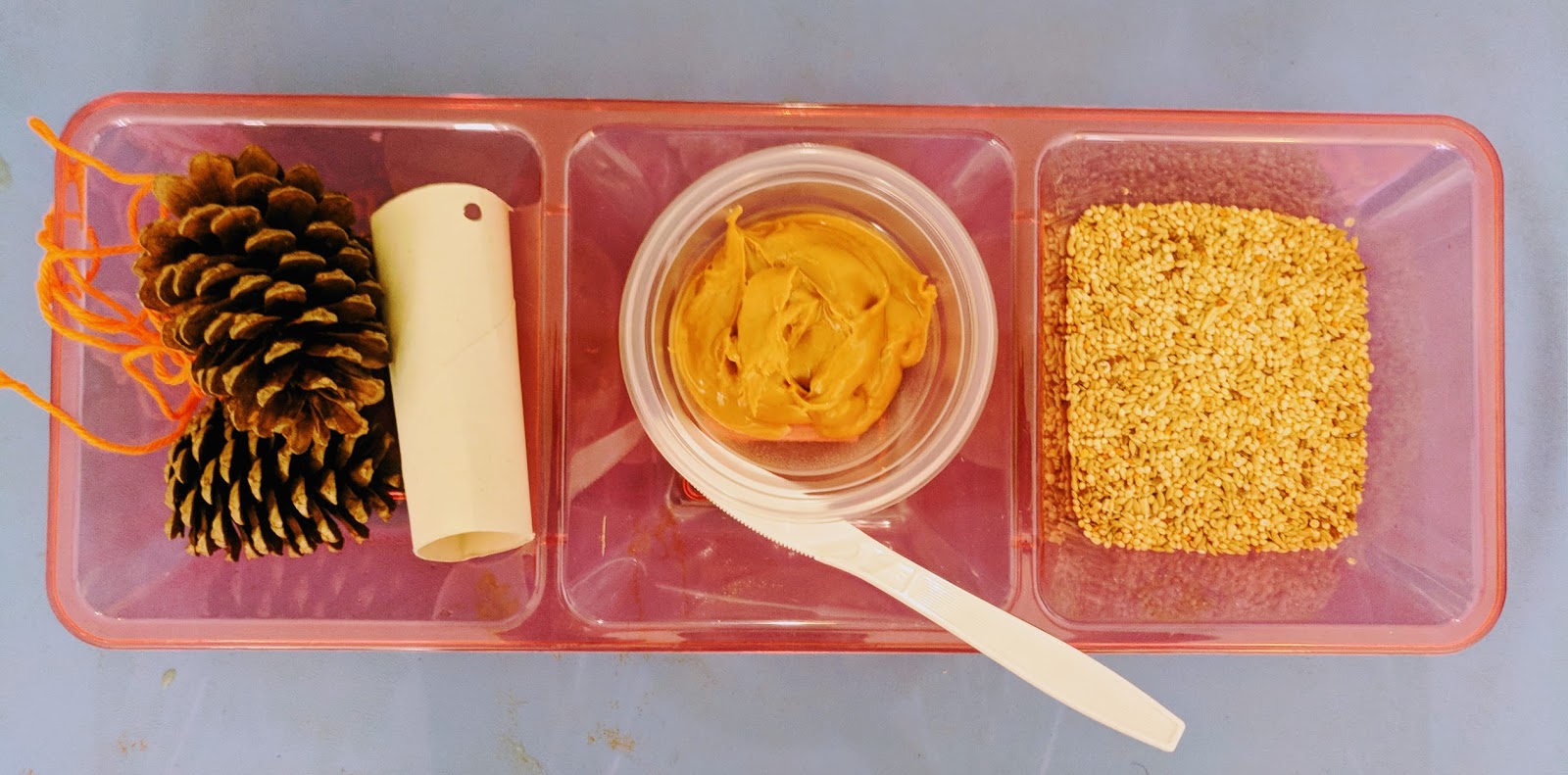
S loves making bird treats for the hungry birdies in our neighborhood. I have a tray all set up to bring outside today (we're having some great weather this afternoon) with our favorite bird treat making ingredients: pine cones, toilet paper tubes, yarn for hanging, peanut butter, a plastic knife for spreading and birdseed! Bon appetit, tweet tweet, enjoy the treat birdies!

Our Fly in the Sky and Swim in the Sea sorting game is a fun way to encourage sorting skills and inspire dramatic play. We have an oddly large collection of plush birds and fish. I also added in some printed and laminated photos of the sky and the ocean as well as some sentence strips to add some print and early literacy to our environment. 
It's Throwback Thursday to when S and I last bought fish for our tank. We're, um, down to one left and S loves to help take care of it and feed it. We will have to take another pet store field trip soon to bring home a couple of friends for our remaining tenant. S and Y both love going to to the pet store and looking at all the fish and birds!
Both boys are still napping, and many days that is truly a blessing! Today, I really can't wait to play, so I think I'm off to go wake up S--and surely Y will follow...

Happy Playing!

Thursday, August 3, 2017

Beyond the Book: The Rainbow Fish by Marcus Pfister

It's time for our weekly story stretcher and this week, per S's request for a book about fish, we dived right into one of my favorite children's books, The Rainbow Fish by Marcus Pfister. This book is about a fish who has many beautiful, sparkling scales but not many friends. The other fish in the ocean greatly admire his beauty and ask for him to share his precious, rainbow scales. The Rainbow Fish longs for friendship but struggles to share his most prized possessions. This book has some fabulous sub-themes, including rainbows/colors, fish/the ocean, and, of course, friendship and sharing. It is a great book to use with a group of students or a couple of siblings. 

Before I go into our activities for the week, let's talk a bit about sharing. In this book, the Rainbow Fish learns that it is better to have many friends than many material possessions. He ends up sharing all but one of his beautiful scales, but feels happy rather than less beautiful in the end. He is no longer lonely and is well liked by his peers. That's all lovely and sweet, but now let's get real. Sharing is about as natural for most children as our current president's tan. In fact, even many adults find sharing to be difficult. How often do you let your spouse or your children have your cell phone? How often do you give your best friend your shirt? The reality is that we all have things that our "ours" and things that are "community items," or things to be shared. For children, sharing is an act not only in letting go of something they truly like and want, but also an act of trusting they will get it back. That's hard! Before we have friends over here, I often ask S if there are any toys he would not like to share and put away for later. Sometimes even during a play date, a toy will be taken out of the mix if it is especially hard to share. We visit public play places to practice using toys that are "community items" for everyone to share. We foster opportunities to practice taking turns both in our home and away. We use a visual timer or a song as needed to designate the length of a "turn." My husband and I model sharing and give language around it, even at the dinner table if S asks for something from our plates. "I'm sharing my dessert with you." We have successes and challenges and it is important to keep our adult expectations on the matter realistic. Sharing is not always easy and it certainly is not a natural process for young children. Some children are more natural "sharers" than others--and no child is able to be a sharer all of the time.  The Rainbow Fish is a great book to demonstrate the challenges that come along with sharing special items and making friends.

And now onto our week's activities to take you beyond the book:

We've been doing our story stretchers in the afternoon. After his nap, S often needs some open play time to ease back into the day and setting out some theme related toys for both brothers was a great way to lure them into our story stretcher. 
S was soon ready to read! He was totally into the book. Y was totally into watching his brother!


As part of our story stretcher, we reviewed the letter Ff in this great do-a-dot sheet available for print from The Measured Mom. They work very well with dot markers, glass gems, dot stickers, pom poms and more...

I set out this Rainbow and Fish process art invitation along with a supplemental story, What Makes a Rainbow? A Magic Ribbon Book by Betty Ann Schwartz. I included Alex Rainbow Crayons, a selection of standard crayons taped across the center in rainbow colors and a couple of sets of skinny Mr. Sketch markers taped across the middle in rainbow order for creating a variety of rainbows and doodles. I also included a selection of fish stickers in rainbow colors.

I love setting out drawing and art opportunities on the floor. It invites children to work on their tummies (as pictured above) where they can practice building upper body strength and have more control between their bent elbows and hands. This is great for pre-writers and early writers as well as children who may display muscle weakness associated with writing. 
Y really liked What Makes a Rainbow?


I created a game to play called "Frogs and Fishies Share the Pond." To set it up, I used a selection of fish and frog paper die cuts (available from Dollar Tree) and wrote prompts pertinent to our family like "Pick a toy to share with your brother" or "Mommy shares a toy with S" or "ask someone to have a turn with the toy they are holding." I attached a paperclip to the mouth of each fish and frog and included a makeshift fishing rod with a magnet on the end. In a basket, we collected a variety of toys from around the house. I designated S as the "Fisherman," however, you can have players take turns going fishing. I would not suggest including any child's special transitional object in the mix as these are inherently hard to share--even if just for a short time and as part of a game. To play the game, each player starts with one toy from the basket. The Fisherman fishes for a frog or fish in the pond. Older readers or an adult can read the prompt. The player fulfills the action on the prompt for the course of one song. You can use a CD or recorded music or you may allow the player to pick a song to sing to designate the "turn." For instance, the player may have a frog that says "share a toy with your Mommy" and the player can hand his toy to the recipient and choose to sing the ABCs while he waits to have it returned. It's a great opportunity to also demonstrate and model language around sharing toys. 

S particularly liked this game! He was able to practice and roll play sharing our family's toys in a controlled and safe setting.

This invitation to create a rainbow fish collage was a fun way to use up some old scraps of shiny paper and patterned paper. Along with some glue, they really added pizzazz to these die cut fishies!

In our Invitation to Create a Rainbow Fish Sculpture, we used Crayola Model Magic Clay dyed blue with some food coloring, google eyes and a variety of colorful buttons and plastic gems. I also provided some fish shaped cookie cutters and a rolling pin. S needed a little help rolling the dough as it is a bit stiffer than standard play dough. It air dries beautifully and makes great magnets if you wish to glue a magnet on or lovely sculptures to display.

As he worked, he told great stories about what he was adding, including a traffic light with only red lights and a telephone to call his Poppa! I love how he added the excess clay from around the cookie cutter to the top to create fins!

I often include a sensory bin with our story stretchers and did not this week. If you'd like to add one to your own Rainbow Fish story stretcher, water play with fish/ocean toys would be great or sand/kinetic sand and sea shells. You could also make a batch of rainbow rice!

Next week we will be taking flight with an airplane themed story stretcher. Until then...happy playing!

Wednesday, July 19, 2017

Beyond the Book (and Song!): Baby Beluga by Raffi

When S asked to do a story stretcher with a book about a whale this week, I knew it was a great time to check out a copy of Raffi's Baby Beluga with illustrations by Ashley Wolff from our local library. This illustrated version of the classic Raffi song is a great book to sing a read together. I can remember listening to the song on cassette tape when I was little and now, you can even watch it and listen on YouTube! Oh, how the times have changed...this video even has footage of actual beluga whales:


We have transitioned to doing story stretcher activities once a week or over a couple of afternoons. Lately both boys have really been enjoying outings and story times at the library in the mornings and we save our story stretchers for afternoons at home (when it's way too hot to go outside). For this story stretcher, we even took a theme related field trip to our local science museum. There is currently a great exhibit of artwork and sculptures created in the image of ocean life made from recycled materials found on the beach. It is a great way to teach our children the importance of recycling and disposing items that cannot be recycled in an appropriate manner so that they do not harm our beaches, oceans and sea life. It is also great fun to walk through and see!
This whale rib cage is made entirely from plastic bottles and containers!

These drums sound great! They are made from Styrofoam found and rescued from the beach. 


We started off our story stretcher by reading and singing Baby Beluga and enjoyed a whale themed snack. Please excuse my creative license with this banana whale! S loved it and didn't mind that it maybe doesn't quite look photo worthy... Incidentally, if you have a reluctant reader who is less likely to sit through a longer book or even an enthusiastic reader who is just not in the mood for a story, reading during snacks or meals is a great way to sneak reading together into your routine. It's also a great "distraction" for picky eaters who have a harder time getting through meals and snacks without a battle. Whether we're struggling with one issue or the other, combining the two aspects of reading together and sharing a meal have proven successful every time!

YouTube was a great resource for videos about whales and live footage. We don't live very close to an aquarium, although we are only a couple of hours from a great marine center in Virginia Beach. In the meantime, the internet had to suffice, along with some great themed play and learning activities. These activities are simple enough to combine into one afternoon or to do individually for a short story stretch when you're short on time, energy or resources:

The Measured Mom has great printable dot sticker/do-a-dot worksheets for every letter of the alphabet. We used this one at our easel (for a vertical work opportunity) along with dot stickers to review the letter Ww! You could use do-a-dot markers instead or even use it on a horizontal surface with glass stones (which can be found at Dollar Tree or your local craft supply store) for an activity you can use multiple times.

I set up a very simple soapy water sensory bin with ocean mammals for S to play with in the kitchen while I made dinner. A little pro-tip--if you're looking for plastic animals, thrift stores are a great resource. Plastic animals can be quite pricey, but I've made some great finds at secondhand stores. We tend to throw in some soapy water play whenever the sensory table (or some toys or the kitchen floor) need a good washing! I added a few drops of blue food coloring to create the look of the ocean and you could certainly add more to this--glass stones, other props or toys for pouring and filling. I know S well enough to know he will search the house for creative things to add so I like to start it off quite simply at first and see where he takes it!
 This brown paper bag whale craft is simple, fun (as in you can hang it up when you're done or play with it) and incorporates the concept of recycling "trash" rather than allowing it to pollute our earth and oceans. I prepped the brown bag with eyes and a mouth; older artists can do this independently. I set out kwik stix and creamy crayons in an assortment of ocean themed colors. You can use any art medium. We really love these right now, but paint, crayons, markers or tissue/scrap paper collage would work well too! Once your artist is done decorating the bag, you can stuff it partially with recycled plastic grocery bags or newspaper or even packing materials from your recent Amazon Prime Day purchases! Leave some room for a tail and tie it off with a rubber band or pipe cleaners. I used a hole punch to make a hole at the top center of the whale and we added a silver pipe cleaner cut in half and bent/folded to resemble water being blown through the whale's blowhole. Did you know beluga whales can blow bubbles through their blowholes? I just learned this! In fact, they can supposedly blow bubbles of different sizes based on how they are feeling. Fascinating, right? If you're looking to extend your story stretcher, blowing bubbles of different sizes would be a great activity to take outside. We had a lot of fun with this whale of a tale. S has already requested a book about a farm for our next story stretcher, so we will be back with some farm themed fun next time. Until then...happy playing!

Friday, August 26, 2016

Think Outside the Box: How To Get Those Dishes Washed With(OUT) a Toddler Underfoot

How do you get dishes done or dinner on the table without your little ones underfoot? I've recently had some success trying something new. HINT: it's not Daniel Tiger's Neighborhood, although has its time and place here, too!
Actually, it's sensory play! Sensory bins are fun for all ages. They are versatile, they can be used repeatedly and in many different ways and they tend to captivate attention for a decent amount of time--even from the youngest little explorers. They can be created at home without breaking the bank using many materials you likely already have and others that can be purchased inexpensively, even at discount/dollar stores. But let's face it, sensory play can get messy! I have a few tried and true tips for this. One is to use a drop mat underneath your work area, whether it's below a table or your bin is directly on the floor. You can use a sheet, a tablecloth (vinyl ones are especially useful if your sensory material is wet), a towel or a shower curtain. Clean up can be as simple as gathering up the mat, shaking contents still usable directly into the bin again for next time or shaking away remnants outside/in the trash. When the drop mat gets too dirty, you can throw it in the wash or, if it's disposable (like a paper tablecloth or plastic liner from a discount store), you can part with it altogether. Another tried and true tip is to take these activities outside. Sometimes, weather doesn't cooperate with this plan, and the heat here has been really unbearable for me. That has admittedly led to a significant decrease in sensory play around here--until I remembered yet another tried and true solution: sensory play in the KITCHEN!

The kitchen, you ask?! Yes, the kitchen! Our kitchen floor is cleaned and mopped more frequently than any other floor in our house, and it's still always needing a good washing again. We live in an apartment and our kitchen space is rather small--especially when you keep a kosher home (two sets of everything and separate prep/cooking areas). Our kitchen also houses our laundry room (well, closet), which, incidentally is also the most frequently used facility in this house that is always needing to be used again. I can almost always find a towel waiting to be washed to throw down on the floor beneath a bin of one of my son's favorite sensory materials. It can be as simple as a plastic bin with soapy water and some dishes for washing, scooping and pouring. The bonus? Your floor is likely to get a good washing in the process and your towels needed to be thrown in the laundry anyway--when playtime is done, dry, toss in the laundry and walk away! Amazingly no matter how many times we've brought this activity out, washing dishes is something my son never tires of. (Why can't I share in that sentiment?) We've had a lot of fun also washing vegetables to prep for a recipe--and then you get the added bonus of your little one having a hand in getting supper on the table, a factor sometimes helpful in making him more likely to try the aforementioned recipe.

Yesterday as part of our UNPLANNED End of Summer Fun, I revisited a favorite theme of ours, Camping IN. We pitched our play tent in the living room, got out our handmade felt fishing set and played the day away. When it was time for me to tackle that stack of dishes in the sink, we took the fun into the kitchen with some Waterbead Ice Cube Fishing.

I prepped the ice cube fishies in the morning--just water, food color (next time I will NOT use orange, it looked a little iffy when melting), and a couple of google eyes in each compartment of an ice cube tray--and popped it in the freezer for later. We had some waterbeads (from the Dollar Tree floral section) we had prepared a few weeks earlier. I prepped his work area with a towel to soak up splatters, added some water and a set of Dollar Tree tongs to our plastic bin (also Dollar Tree), and he had so much fun, he was still playing when the dishes were done. When the fishing was done, I strained out the waterbeads, collected the google eyes to put away for another project and replaced the waterbeads to the bin. I added a few drops of lavender essential oil for some calm evening play. My son still wanted to use the tongs with them--what great fine motor practice!


Sensory bins are such a versatile and developmentally important activity for children, but they need not break the bank. There are a lot of wonderful sensory tables out there for purchase and a lot of creative ways to fill them beyond the classic water or sand. Here are some more outside-of-the-box ways we incorporate sensory play here:


  • a large and shallow plastic bin with a lid can be put directly on the floor for play--little ones often have fun climbing right in! They can also be placed on a child's table for standing play
  • smaller plastic basins, bowls or disposable baking pans can make for great sensory bins as well--plus they are easily transportable
  • I keep a few shoebox sized plastic bins with ready-to-go sensory materials to use indoors or out
  • Even pencil box sized containers with lids can be used for travel sized sensory bin play--one of my favorites is one we keep filled with kinetic sand and seashells collected on a family vacation
  • Overall storage of sensory materials can easily be done in plastic containers with lids or ziplock bags
  • I keep a stash of recycled plastic containers, cardboard tubes, and discount store scoops, shovels, bowls, cups, plastic spoons, etc., for scooping, pouring and exploring
  • Plastic animals, figurines, and other such toys and miniatures make for great small world additions to sensory play
And now for some in and out of the box filler ideas:

  • water is a classic and always fun--you can add a bit of dish soap for washing and toss in a sponge or you can add some food color and jars/containers for pouring and color mixing exploration
  • rice
  • dry beans or lentils
  • dry pasta
  • waterbeads
  • pom poms
  • glass craft stones
  • flour
  • shaving cream
  • play sand
  • soil
  • dry corn kernels
  • straw
  • dry oats
  • items collected from nature (leaves, pine cones, acorns, twigs)
Happy playing, and may your fun stay inside the bin but outside of the box!