Showing posts with label sorting activities. Show all posts

Wednesday, January 3, 2018

Beyond the Book: "Gregory, the Terrible Eater" by Mitchell Sharmat

It's been a while since we did a story stretcher here, and with temperatures outside cold enough to ice your coffee--literally (see photo to the left), an afternoon indoors is definitely in order. S has been learning about health and nutrition in school this week. He is very happy to be back in preschool! He loves being there and gains a great deal from the experience. He is, nonetheless, often reluctant (as many children are) to share about his day after I pick him up. I am creative with how and when I ask questions. Open-ended questions right upon pick-up, like "how was your day?" or "what did you do today?" are often met with silence. For one thing, he is very ready for a nap at that point and this transition is a challenging one. For another, the question really puts him on the spot and one thing he can control at three years old is what, when, and how he answers. Many days I will simply ask "would you like to tell me about school now or later?" He often says "later," and sometimes he says "now!" I ask more specific questions on some days, like "what made you laugh?" or "who did you play with on the playground?" And on all days, the  best glimpse I get into S's school experience is through his play. He will play about, sing about and talk about his school day throughout his time at home--you simply have to catch him in the act!


Another area that is a hot bed for three year old control is eating. I am here to tell you thirty years after being S's age that I am a fully recovered Terrible Eater. Before I was a parent, I vowed I would not be a short order cook the way my own mother was, often preparing three different dinners and barely sitting down to one herself. Y has been a total chow-hound these days, yet to meet a food he does not love. S began in much the same way, but around the age of two began to show preferences about foods. When his nutrition was less than optimal, we supplemented with homemade smoothies, which he still loves. He eats a variety of healthy foods (and enjoys a variety of less healthy ones), but he is definitely particular still and often reluctant to try new things. He will down a green smoothie, but won't eat a hotdog. He wants the same thing for breakfast and lunch each day. He wants a variety of options for dinner and none of them include what's on our family menu. My husband and I quickly decided not to allow mealtimes to be battlegrounds in our home. The energy level by dinner time is dwindling and it is also a family time after a long day of school, work, and other activities. It feels more important to have peaceful time as a family where there is something for everyone to eat than for everyone to eat the same something.

Gregory, the Terrible Eater by Mitchell Sharmat, illustrated by Jose Aruego and Ariana Dewey is a wonderful, classic children's tale of a goat who adamantly refuses to eat the foods his parents want him to eat. What child or parent can't relate to this? The only difference here is that Gregory favors fruits and vegetables while his parents would prefer he eat the shoelaces and cardboard being served at the family table.

This afternoon, we will enjoy laughing our way through this favorite book along with some fun extension activities. It likely won't change our dinnertime much here, but you never know...

 Eat a Rainbow of Fruits & Veggies Sorting Game

In this DIY sorting activity, I printed and laminated a collection of photos of fruits and vegetables in a rainbow of colors. I also printed off color coded words to label each of six brown paper lunch bags. Alternatively, you can use and label paper plates, use colored gift bags or canvas bags or even color code a six-sectioned party tray. S will have the task to sort the colorful fruits and vegetables into their correct bag. This is a great opportunity to talk about fruits and veggies your family likes or does not like as well as to introduce vocabulary around fruits and veggies you may not have tried yet. You can talk about how important it is to eat a variety of different foods in different colors.

Want to do more? If you have a toy shopping cart or basket or even a recycled/reusable shopping bag, send your little ones on a scavenger hunt through the toy kitchen (or even your real kitchen) to find more foods in each of the colors.


Take a Family Field Trip to the grocery or produce store and let your children choose a new fruit or vegetable to try. If it is something you've never had before, it can be fun to choose a recipe together to prepare it. S is often reluctant to try new foods at first, but if he chooses it, it's a game changer. Additionally, involving him in the preparation process also inspires a brave pallet. When he is particularly averse to trying something, I might offer him to touch it with his tongue. I do not force children (my own or students) to try foods and I also believe there is value in being honest with them about trying new foods. I do use language like "you may like it and you may not like it but you won't know if you like it unless you try it." I also tell them honestly about foods I don't care for as much or examples of times I used to not like something but liked it after trying it several times (like sushi!). Many enthusiasts on the topic steer clear of adults discussing foods they do not like in front of children, but I feel it is helpful to be honest and also to point out that different people like different things at different times and that's OK! It also opens up important conversations about how to politely decline or discuss foods that are not one's favorite.


Dramatic play is a big part of our afternoon fun here. S has been particularly into small world play and this miniature goat, chair and table and our collection of miniature toy food will undoubtedly inspire a great story drama! Y can join in the fun as well with this larger play set with a plush goat and toy food and dishes.


Color, Paste and Taste the Rainbow!

I found a great free printable on Teachers Pay Teachers to use as a template for this activity. I did a bit of prep work to save on time by color coding, but depending on your little ones' level of ability or your availability to assist, you can definitely leave this to them. You can provide printed pictures of fruits, veggies or other foods, stickers or magazine pictures to glue on and crayons for additional coloring.

Want to do even more? My favorite recipes to make each year when parashas Noach comes are rainbow fruit salad and rainbow vegetable salad.  S may prefer the taste of the rainbow in his favorite candy, jelly beans, but he also loves fruit and many vegetables as well. Presenting foods in novel ways is a great way to encourage your own terrible eaters or even just particular/opinionated ones!

There are so many studies to support the benefits of involving children in family nutrition. From farm to store to kitchen to table, participation gives them a connection to the important process of feeding and nourishing their bodies. S really loves to help in the kitchen. Y loves to be in there with me as well (especially if eating is involved or loudly banging pots and pans). For those times when I need to plow through a stack of dishes or prepare dinner with fewer cooks in the kitchen, the sensory table (also in the kitchen) is a great lure. In this simple sensory bin, just add soapy water and let your little hands scrub some fruits and veggies in a rainbow of colors! S has also enjoyed scrubbing actual fruits and veggies in the past (which is particularly helpful when I am making vegetable soup or a salad!) but soapy water and some interesting sponges or scrub brushes are always fun for little hands, no matter what is in the bin along with it.

We're off to an afternoon of good reading and food for thought. Happy Playing!

Thursday, November 16, 2017

Days of Creation Play Stations: Day 5 Fish & Birds

We're up to Day 5 in our Days of Creation Play Stations! I have really loved the opportunity to focus an afternoon here and there on sensory play, process art and play activities related to each of the days of Creation with both boys. Although we are well past the reading of Parshas Bereishis in the Torah, it has been a great opportunity to slow down and really focus on each of the days individually. Speaking of slowing down and focusing, did anyone else notice I never posted about what we did for Day 3?! So before we get to the birds in the sky and the fish in the sea....

Here's a peek at what we did for the third day, when Hashem created the earth and grass, flowers and trees:

 We added a third sensory bottle with dried black beans and artificial flowers and leaves. We also incorporated the current season of Autumn into this theme and did what makes the most sense when playing about things that grow outdoors...

...we took a trip to the park! In fact, I posted about that trip and a story stretcher I brought along in this post. As we read, walked, collected, played and made leaf bracelets and leaf rubbings, we also talked about the parts of Creation that took place on Day 3. The next day, we used a collection of pine cones and Fall leaves and acorns along with some marigolds from our garden and some leftover flowers from the previous Shabbos to make "nature paint brushes." S (and Y with some help) got to try their hands at these unique brushes for painting on the third page of our Bereishis Process Art Book.


 That was about the extent of our Day 3 activities since at the same time all four of us shared a cold and three of us shared a case of bacterial conjunctivitis. There were enough green noses and pink eyes here to decorate a Lilly Pulitzer dress and that may or may not be why I totally forgot to post on it!


The great thing about taking the Days of Creation literally one day at a time is that you can take all the breaks you need for recovering from illness, getting busy with other activities and events and still come back to it again. S is always excited when I tell him we will have an afternoon devoted to Days of Creation Play Stations and surely both boys will enjoy what I've got in store for today...


Y has been eating up a storm! Faster than I can keep up, but thank goodness for those handy little jars of baby food for when I don't have the time to make my own purees. And, if you know me, you totally know I had my eye on those little jars for another reason as well--sensory bottles! As with anything made from glass,  adult supervision is certainly a requirement. Baby food jars are a thicker glass and the perfect size for small hands to grasp. Our Day 5 sensory bottles worked best in 2 parts...this "I Spy a Birdie" sensory jar with birdseed and bird buttons...

...and this "Swim With the Fishies" sensory jar with water dyed blue, baby oil, blue glitter and fish buttons! Both jars are hot glued and duct taped shut to ensure that what's in the jar stays in the jar even if shaken vigorously! 

Our DIY Fish Squish Bag is made from a 2.5 gallon ziplock bag filled about 1/4 of the way with water that I added blue food coloring to. I also added in some goldfish cut from craft foam with eyes and smiles drawn on in permanent marker. Additionally, I added a handful of glass craft stones. Before zipping the bag, I let out as much air as possible so that when it is laid on a flat surface it can be squished and manipulated by little hands without a risk of popping. I duct taped the zipper end for extra protection and it's ready to go! Y will love using this on his tummy and it is a great way to encourage tummy time. Y will probably also really enjoy it. I also searched the internet for some photos of common fish and birds in our state to print and laminate for the boys to look at. 

Our small world bird sensory bin is also ready to go, with shredded craft paper, wood circles, pine cones, sticks, bark and acorns collected from previous park trips and some resident birds as well. We used a similar set up before last Tu B'Shevat and S really liked feeding the birds birdseed, so I also included a small dish of birdseed with a tiny spoon.

S really loves using the sensory table in our kitchen and will surely enjoy seeing this colorful poster of regional birds nearby. Perhaps it will also inspire him to peer out the window and see which ones he can find in our backyard!

I found this birdhouse at the beginning of last summer and today is the perfect day for S to decorate it! It will make a great play accessory to add to our small world bird sensory bin when he is done, although I have a feeling he will want to hang it up outside for the real birds, in which case I had a jar of Mod Podge on the ready!

Our Day 5 page is ready for some process art. I created "ocean bubble brushes" with bubble wrap and "bird feather brushes" with craft feathers, both clipped to clothespins. If your little artists like to get their hands painty, feel free to just set out bubble wrap and feathers. I like the clothespins for children who prefer not to get their hands painty or in general for easier grasp of the materials while painting. 

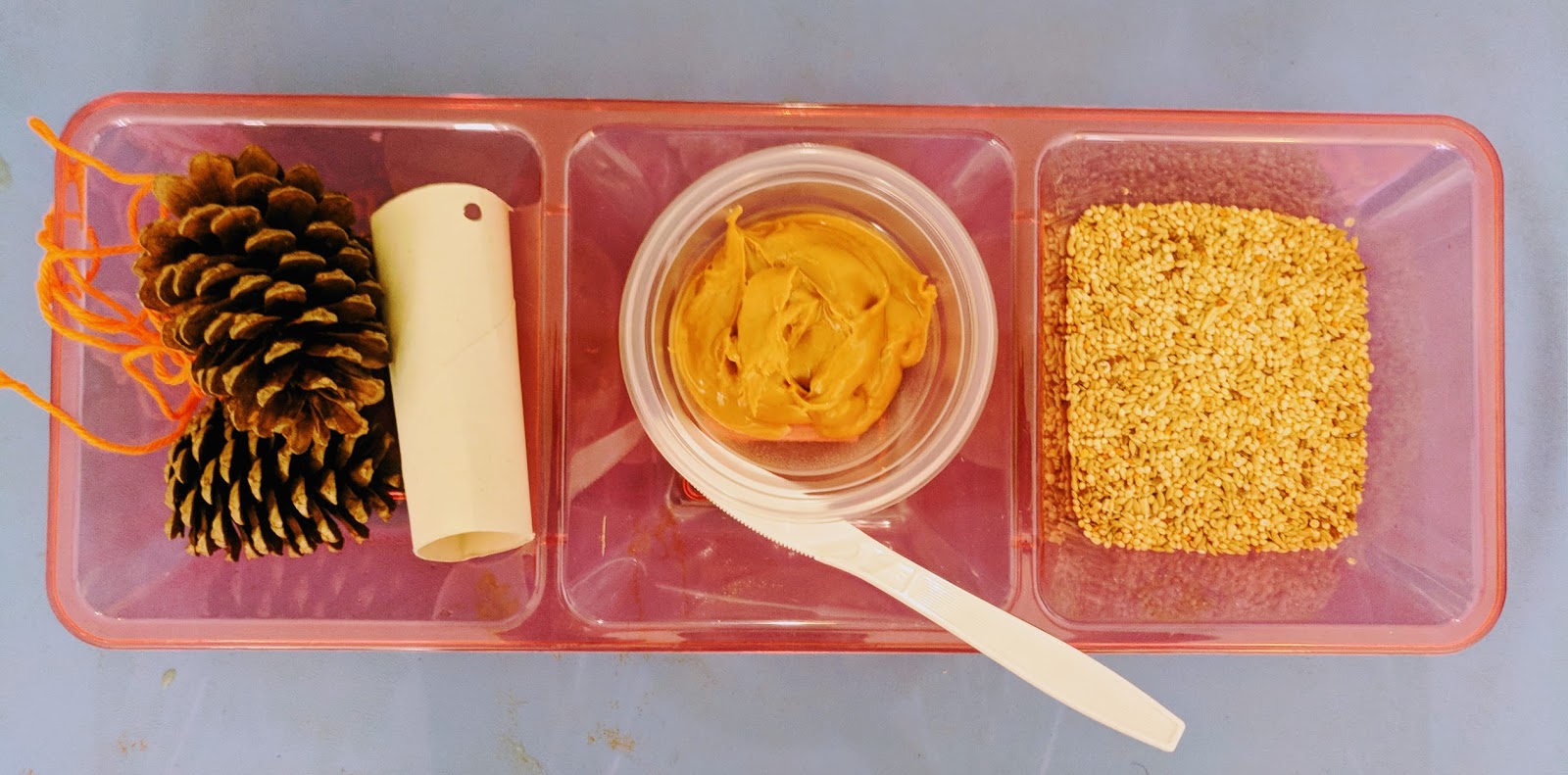
S loves making bird treats for the hungry birdies in our neighborhood. I have a tray all set up to bring outside today (we're having some great weather this afternoon) with our favorite bird treat making ingredients: pine cones, toilet paper tubes, yarn for hanging, peanut butter, a plastic knife for spreading and birdseed! Bon appetit, tweet tweet, enjoy the treat birdies!

Our Fly in the Sky and Swim in the Sea sorting game is a fun way to encourage sorting skills and inspire dramatic play. We have an oddly large collection of plush birds and fish. I also added in some printed and laminated photos of the sky and the ocean as well as some sentence strips to add some print and early literacy to our environment. 
It's Throwback Thursday to when S and I last bought fish for our tank. We're, um, down to one left and S loves to help take care of it and feed it. We will have to take another pet store field trip soon to bring home a couple of friends for our remaining tenant. S and Y both love going to to the pet store and looking at all the fish and birds!
Both boys are still napping, and many days that is truly a blessing! Today, I really can't wait to play, so I think I'm off to go wake up S--and surely Y will follow...

Happy Playing!

Monday, September 25, 2017

Yom Kippur Play & Learning Activities for the Young (and Very Young)


We've dipped our apples in honey (maybe even double dipped, but shh, don't tell!) and that means Yom Kippur is just around the corner. This seemingly somber occasion does not immediately give way to images of playfulness as we imagine a day of feeding and entertaining little ones while simultaneously trying to fast and atone for a year's worth of bad behavior when we were hangry. Yom Kippur is, nonetheless, an important and even joyful holiday. It is a beautiful opportunity to connect with Hashem on a very deep level as we prepare for the year ahead. As with all holidays, I like to teach about Yom Kippur through play and introduce children to the important symbols and customs of the holiday. Here's a peek at some of my favorite play and learning activities for Yom Kippur for the young (and very young):


 For starters, with young children, we focus the teaching of Yom Kippur on acting with chesed, being a good friend and, when we make a mistake, saying we are sorry. Since I am not a parent (or teacher) who forces apologies "in the moment," but rather teaches empathy through modeling and assisted problem solving, I like that Yom Kippur introduces a time to talk about apologies in a general sense. I love books like Sammy the Spider's First Yom Kippur by Sylvia Rouss and The Hardest Word: A Yom Kippur Story byJacqueline Jules for preschool aged children. Additionally, books that teach about managing strong emotions are another good choice for this time of year. I particularly like When Sophie Gets Angry--Really, Really Angry and When Sophie's Feelings Are Really, Really Hurt by Molly Bang. Incorporating discussions about friendships and kindness are appropriate at this time of year.

Giving extra tzedakah (charity) is also a common practice before Yom Kippur. For the very young, this DIY toy tzedakah box is a fun activity to introduce fine motor skills to teeny tiny hands:
A recycled cocoa powder container and plastic coins make a fun toy tzedakah box. Be mindful of small pieces with very young children. Older children can also decorate a tzedakah box to actually use and fill with money.

 Speaking of the very young, I love using discovery baskets with infants and young toddlers for play. In corresponding to a Yom Kippur theme, I might fill a discovery basket with household objects and toys that are white to introduce the idea that we wear white on Yom Kippur. Older babies and children might like to use a sensory bin with white filling (such as cotton balls, shredded paper, plain rice or shaving cream).

I also introduce the story of Jonah and the Big Fish during the Yom Kippur season as it is read during the holiday services each year. I water down the story for young children (pun intended) and I particularly like the free printable version and activity pack available at A Jewish Homeschool Blog.
We had a lot of fun last year with this balloon big fish/whale craft. S colored a paper plate blue and I blew up a balloon with a Lego man Jonah inside! I drew on a face and cut/attached the fins for a playful version of the big fish with Jonah in its belly! Do supervise young children with balloons as they can be a choking hazard if they pop.

The very young can also enjoy a balloon big fish! Y loved kicking and swatting the balloon from his back and later on his tummy. I made a new set of balloon big fish this year just for that purpose!

Our sensory bin is set up with a simple invitation to play about Jonah and the big fish, complete with a ship, a toy "Jonah" and a whale (big fish). Just add water and you're ready to play! 

This paper plate fish craft is a fun one for toddlers. Little ones can color two paper plates (we chose blue) and an adult can help with cutting/assembly and any additional details (like eyes and a mouth). Cut a circle out of the "body" plate and cover with clear contact paper or packing tape, sticky side up. Little hands can scrunch and stick on tissue paper to the center.

The story of Jonah and the Big Fish also lends itself to some great science experiments and explorations. You may wish to take the opportunity to study whales like we did in this post. You might also explore the mechanics of boats as we did in this post. Sink and float experiments are a great addition to your play and learning this time of year. You might even have your own boat building/testing contest!


A blast from the past!


And while we're on the topic of water, if you haven't had a chance yet to do tashlich and teach/play about it, it's best to do so before Yom Kippur. I love this paper plate craft, done in a similar fashion to the whale craft above. Hollow the center of a white paper plate and cover with clear contact paper or packing tape, sticky side up. The outer plate can be decorated to look like the outside of a pond and the inside can be filled with blue tissue paper "water" and fish cut from paper in the colors of your choice. This helps teach the concept that we do tashlich in an area with water and fish.
If you're feeling particularly ambitious, you might even take a trip to your pet shop and buy a goldfish of your very own. S loved that part last year. It's a great way to teach young children about the responsibilities of caring for a pet (that luckily doesn't cost more than 33 cents since in spite of the price, they are rather challenging to take care of sometimes!).


With preschool aged children, there are a variety of sorting games and activities that can help teach some of the practices and customs of Yom Kippur. I like to use pictures or photos of Yom Kippur symbols to play:

On Yom Kippur We Do and We Do Not:
Using pictures or photos (with or without written text), and a large piece of chart paper or a large space on the floor, have your child(ren) help you sort things we do on Yom Kippur from things we do not do on Yom Kippur. You can tailor your selection to meet the customs Byour own family. You might include:
We Do:
  • daven to Hashem
  • go to synagogue
  • wear white/wear a kittel
  • give extra tzedakah
  • act with kindness/ahavat yisrael
  • say we are sorry
We Do Not:
  • eat or drink (adults only)
  • wear leather
  • wash our hands or bodies
  • drive cars, use electronics, etc.
I also like to introduce the concepts of "before," "during" and "after" to older preschoolers in this activity:

Before, During and After Yom Kippur:
Using pictures or photos and a large sheet of chart paper or space on the floor, have children help sort activities that are done before, during and after the holiday. You might include:
Before Yom Kippur, we:
  • give extra tzedakah
  • do kapparos
  • light Yom Tov candles
  • eat a seudah (special meal)
During Yom Kippur, we:
  • fast (adults only)
  • wear white
  • wear non-leather shoes
  • go to synagogue
  • daven to Hashem
After Yom Kippur, we:
  • hear the shofar one last time
  • make havdalah
  • celebrate the new year ahead and break our fast with a festive meal
  • begin to build our sukkah for Sukkot
Younger children can also get in on the sorting fun. Just grab your families selection of non-leather shoes (if you're like us, you have crocs in all colors and sizes!) and play a game of shoe/slipper match-it!


Lastly, teaching young children about kapparos can be a great opportunity for a cute little craft, like this chicken stick puppet S and I made last year. We do not happen to use actual chickens where we live for kapparos, but S had a great time swinging this feathered friend around his head last year! I prepped a cut the shape of a chicken and S got to glue on the feathers. Attach a craft stick handle and you're in business!


Yom Kippur is one of the most special and sacred holidays of the year. It is not always an easy one for adults, but through the lens of our children's wonder and curiosity, we can learn again how to approach this time of year with joy, and, as always, through play!

Happy Playing!

Wednesday, September 13, 2017

Beyond the Book(s): Mo Willem's Pigeon Books

I am a huge fan of author and illustrator, Mo Willems. His characters capture early childhood in a cute, amusing and playful light. They are also easy to relate to for children (and adults alike)! I could not wait to introduce his books to my own children, and Knuffle Bunny was one of the very first we owned when S was just an infant. Fast forward 3 years, and we are frequent flyers in the W section of the children's fiction department at our library. (Sorry if you were there this week and looking for any books by Mo Willems...) When S asked last week to do our story stretcher this week with a Pigeon book, I thought, why stop at just one? Let's do an author study, grab a bunch of Pigeon books, maybe a bus, a hot dog, or even a cookie, and GO!
Rather than starting with a target book, I set out a variety of Pigeon books around the room with corresponding activities. If the Pigeon drives a bus today, he will have many fun and playful stops to make along the way!
Here are a few of our favorite Pigeon books by Mo Willems:


  • Don't Let the Pigeon Drive the Bus
  • Don't Let the Pigeon Stay Up Late
  • The Duckling Gets a Cookie?!
  • The Pigeon Needs a Bath
  • The Pigeon Finds a Hot Dog
  • The Pigeon Wants a Puppy!

and in board book form for Pigeon fans in training:
  • The Pigeon Loves Things That Go
  • The Pigeon Has Feelings, Too
We loved Mo Willems' website, www.pigeonpresents.com, where Pigeon fans of all ages can enjoy games and activities featuring their favorite characters. This is a great way to introduce computer use to young learners!

For my pre-writer turned preschooler, we are working on letter and name recognition. S saw these giant googly eyes in the craft store a while ago and wanted them. I admittedly really liked them but couldn't think of how we would use them. As soon as I came up with our plan for this week, I knew I wanted to make some Pigeon hats and drove right back to the craft store to grab a set!

So I may be crafty, but I'm not the best engineer! I used blue poster board and white and yellow cardstock, a giant (and heavy) googly eye plus some staples, glue, tape, and black marker for details. Even with the addition of a wooden craft stick for support to the back of the Pigeon head, these were a bit too top heavy. No problem--we used them for a photo op, printed off the photos and created this next activity: 

* If you want a Pigeon hat that doesn't flop down, leave the giant googly eyes for another day and stick to card stock or paper for your eyeball!

Don't Let _____ Drive the Bus Collage
For this playful little picture, I printed off an image of a schoolbus and the text, "Don't Let ______ Drive the Bus!" S is already able to verbally spell his name and recognize his name in text. In advance, I wrote his name at the top of one page and Y's name at the top of the other. I printed off photos of each brother in his Pigeon hat and S went to work figuring out whose bus was whose! He glued on the photos to each bus and decorated the scenery with crayons.

We didn't let those giant googly eyed Pigeon heads go to waste either--I just added a body and some pipe cleaner legs for this next game--a great one to accompany Don't Let the Pigeon Stay Up Late and help little ones practice visual recognition of morning and nighttime routines. 


Good Morning, Pigeon & Good Night, Pigeon Sorting Game

In addition to my makeshift Pigeons, I added a sentence strip with the text "Good Morning" and one with the text "Good Night." I also printed and cut out a variety of morning routine and bedtime routine clip art. I liked many of the ones available on the free printable Good Morning and Good Night Checklists at A Jewish Homeschool Blog, and to fill in any relevant gaps, I did an image search online. I also printed off pictures of a sun and a moon to help my pre-reader identify which Pigeon was featuring which routine. You can play the game in a variety of ways with your little ones. We set out all of the pictures and I talked S through the tasks and activities we do each morning and each night so he could find the pictures. He placed a bit of glue on the back of each picture to glue it on to the correct Pigeon. You could also have a more advanced child carry this out more independently or for more independence at an earlier stage, you can eliminate the sorting aspect and instead just set out pictures and the Pigeon for one part of the day at a time. The best part of the game is that you automatically win two giant Pigeon posters for your child's bedroom to help him navigate his morning and bedtime routines. Just remember, don't let your pigeons stay up late...or be late for school!


Readers and Writers Unite!

Pigeon books bring up all kinds of familiar feelings about following rules. The world of a child is full of things we adults won't let him do. Incidentally, much against my own childhood imaginings, adulthood is not much different! Even I can't drive a bus. Nonetheless, your little reader may already be thinking about things he feels the same way about as the Pigeon. He may even want to write or illustrate about it like Mo Willems!

For writers who are still in the doodling and scribbling stage, check out this "Don't Let the Pigeon Drive the ___" free printable available at Teachers Pay Teachers

For more advanced writers or illustrators with a longer attention span, check out this free printable "Don't Let the Pigeon..." book! It's guaranteed to earn an honored space on your bookshelf next to all of Mo Willems' books!


The Pigeon Gets a Bath

Whether he likes it or not, the Pigeon is going to get a bath with this activity! I printed off an image of our beloved Pigeon, laminated it and made him nice and dirty with some dry erase marker doodles. S got to scrub him clean with a little wash cloth and had lots of fun getting him dirty again! Don't forget your rubber duckling...


And Happy Playing!
Dramatic play is a big part of our story stretchers. We got out our toy buses, cookies, hot dogs, and some makeshift Pigeon and Duckling stick puppets I crafted from printed and laminated images of the characters. I also set out a discovery basket aimed for Y with props from the board book The Pigeon Loves Things That Go! Now that S and Y were in charge, anyone could drive the bus, eat a cookie or have a hot dog!

Want to Do More?
  • Have a hot dog taste test!
  • Bake and share your favorite cookies!
  • Take a field trip on your local city bus
  • Talk about and write down the rules in your own house on a poster board. Involve your early writers and illustrators. When you're done, hang up the poster for all to see!
  • Read the book The Pigeon Has Feelings, Too! and play "The Make a Face" game: invite all the players to "make a happy face," or "make an angry face," and so on. Make sure to end your game with "make a silly face." That is always our favorite! This is a great way to introduce language and facial expression recognition to young children.
  • Make a wish list. It can be as wacky as you want. The Pigeon wants a lot of things and we all know some kids who feel the same way. Sometimes naming it, writing and drawing it are enough to quell the deepest toddler desire for a puppy, a hot dog, a bus or whatever else the moment calls for...just don't show it to his grandma!
Well, that's a wrap--we'll be back with some more story stretchers after the craziness of the high holiday season. We will be sure to share some of our favorite holiday themed play activities in the weeks to come and until then...

Happy Playing!

Thursday, July 6, 2017

Beyond the Book: Jamberry by Bruce Degen

One of my favorite books growing up was Bruce Degen's Jamberry. This rhyming, somewhat nonsensical story captures a tale of a boy, a bear and a billion berries with a plot that is as whimsical as the illustrations that accompany it. Because I loved this book so much, it is one of the first books we bought when S was a baby in board book form. And the only thing more fun than just reading it is listening to a musical version that I grew up hearing on audio cassette.
Thanks to YouTube, a whole new generation can enjoy the catchy tune of the brass-berry band as they read along!


Now that summer has berry season in full swing, I knew this would be the perfect week to bring out a story stretcher with this great book. We began by taking a field trip to our local produce shop to pick out some fresh berries. If you live near a pick-your-own location, picking berries can be a great family activity to accompany this book! We had just as much fun looking at all the produce in season at the produce shop. We had visited the same store in the fall, so it was nice for S to see how the selection of locally grown produce is different in the summer. 
With a busy week here, this story stretcher is perfect for a rainy afternoon like the one we had yesterday. I began by introducing the book in the morning before we went out for a play-date. After his nap, S was greeted by a berry taste testing station:
I created and printed a simple chart to track which berries we each tried and which were our favorites.

We taste-tested blueberries, raspberries and blackberries. I soaked and washed the berries in advance, but little ones would love the opportunity to help with this step! As it was lunchtime, I also included a fourth bowl of strawberry yogurt, per S's request. S is a huge berry-lover, however, if your little one is trying berries for the first time, you may want to provide just the berries first and than offer yogurt or whipped cream for dipping.

S decided blueberries are his favorite! He had fun eating through all three bowls (with my help!) and liked to eat one type of berry at a time. Some blueberries even made it into his yogurt, but most of them went right into his mouth!

As we tasted and tested our berries, S asked to hear our target book again. This was also a good time to introduce some supplemental reading. Here's a brief list of books we enjoyed along with Jamberry this week:

  • Blueberries For Sal by Robert McCloskey is another great classic about a little girl who goes blueberry picking with her mother, a little bear who goes blueberry picking with his mother and a little mix-up that happens in the process!
  • Bread And Jam For Frances by Russell Hoban was another childhood favorite of mine. It is about a badger named Frances who struggles with picky eating (something I definitely could relate to as a child). She eats bread and jam for every meal of every day but is hesitant to try new foods. After all, she knows what she likes and likes what she knows... Nearly every growing eater can relate to this struggle and as parents, it is a pleasant and comforting reminder to pick our battles with picky eaters.
  • Daniel Tiger's Neighborhood: Daniel Tries a New Food by Becky Friedman appeals to this generation of Daniel Tiger lovers (and also to the previous generous of Mister Rogers fans!) as Daniel Tiger, his friend Miss Elaina and even his dad all try new foods for the first time. 
S loved the opportunity for independence when I invited him to make his own strawberry jam toast. We put the bread into the toaster oven together and then used a cookie cutter to shape it like a heart. I provided him with a small dish of strawberry jam and a plastic knife for spreading. He loved spreading jam onto the toast. Ironically, just like Frances who loves bread and jam and knows what she loves, S also knows what he loves... He asked for a cheese toast as well and was not interested in even trying the jam toast. Such is life! I don't push him to try new foods, but rather offer ample opportunities. I have found taste tests to be a great tool for encouraging this in a positive light. S definitely flocks toward books he can relate to and as such, even requested to read the Daniel Tiger book about trying new foods when I presented this activity. Many times if a food is presented and offered repeatedly, he will eventually try it and eat it. Jam is not something I'm too worried about him eating if he isn't interested; berries in their fresh form are a lot healthier --
Jj is for Jamberry!
Story Stretchers provide us with a great opportunity to review our letters as well. I brought out some berry-hued paint, some sponge brushes to dab and a printout of an uppercase letter J to paint. S liked mixing and layering the colors outside the J and then along the inside. Even the act of filling in a bubble letter in this way introduces early writing skills as children familiarize themselves with the shape and structure of each letter.

One of my favorite parts of Jamberry is when the boy and the bear dance along to the brass-berry band. S and Y both love music and instruments, so we took out our instrument collection, cranked up some John Philip Sousa and formed our own living room band!

S was thrilled with the chance to play his drums and then took to marching around the living room!

Y was a bit wary of this at first...

...but if you can't beat 'em, join 'em!


Once Mommy had enough of the marching band, it was time for a quieter activity, like this simple DIY berry sorting activity. I recycled our berry containers and printed/laminated several images of blueberries, blackberries and raspberries. I labeled each container with a picture taped to the inside and put the remaining collection of laminated pictures in a basket. S loved sorting them and also turned it into a great dramatic play game, including the toy cash register he got for his birthday from his Nana and Poppa, his shopping cart and his brother! Sorting activities are a great way to develop early mathematical concepts--but S would never notice how much he was learning, he was very busy at play!


We had a berry good time jamming to this week's story stretcher pick, Jamberry by Bruce Degen. It's a great book for some summer fun, tasting and, of course, playing!