Showing posts with label outdoor classrooms. Show all posts

Monday, March 2, 2020

Three Great Purim Activities You Can Take Outside!

If costumes inside are fun, imagine
costumes outside at the park!
Today we're going to Get Outside And...PURIM! If this holiday isn't enough fun already, let's take it to the park (or backyard). In fact, that is exactly what we did in our most recent outdoor playgroup event--a Purim Popup Play at the Park. And the best parts about these activities is that you can do them outside or indoors, many of the materials needed are likely in (or outside of) your home, and they can be adapted for year round use.

1. Stick Puppets
Stick Puppet created by
a three year old!
Puppetry is a great way to retell the story of Purim for young children. You can make Purim puppets in a number of ways, but I particularly love using nature's loose parts when I can and sticks are a fabulous loose part. Send your puppeteers on a search for the perfect stick! All you'll need to add to the mix are any loose craft parts you have on hand (we used google eyes, fabric scraps, pipe cleaners, some wool roving and a handful of buttons, gems and sequins). Now here's the one material I can't sing the praises of enough: nontoxic gel medium. I can't believe I made it 35 years before I found out about this! Found in the painting/acrylics section of craft supply stores or online, this works with all the power of a hot glue gun and none of the heat! It is worth the investment as kids can glue loose parts together without the frustration of them falling off while it sets. It takes a very small amount to work and it dries clear. I like to use condiment containers with lids to transport it to the park (or any small dish/piece of cardboard inside) and a craft stick to apply it. Let the kids have at it and design their puppets. They will surely tell some great versions of the Purim story and many other stories to come.

The storytelling continues at home. S is manning
my Stick Puppet and Y is donning a hand dyed cape!
2. Hand Dyed Capes Capes are for more than just superheroes. Wizards, fairies, royalty and just kids who need to fly a little faster might need a cape from time to time. And hand dyeing your own is so fun (and easy)! 
You will need:
  • white flour sack dish cloths (sold in bulk at Walmart or similar stores or even online--even better if you happen to have some stained ones in your kitchen stash that need to be upcycled)
  • liquid watercolor or food coloring or fabric dye (I used liquid watercolors--I am not sure how permanent they will be upon washing so for a permanent dye stick to ones intended for fabric)
  • water to dilute dye
  • pipettes (I bought in bulk on Amazon)
  • glass jars or cups to fill with/transport your dyes
  • foil pans or similar item to work within
  • smocks to cover clothing


The children had so much fun dropping bits of color across the fabric. I separated warm and cool colors initially for the children so they would blend without turning brown, but even those who chose to mix all six colors I provided (red, orange, yellow, green, blue and purple) came up with gorgeous results! If you're outdoors, hang or drape your capes to air dry. Once dry, they can be tied around the shoulders as a cape. They also make fabulous doll blankets, picnic blankets, and whatever else your little ones may come up with.
If you are hosting a park party and need to send these home still damp, I'd recommend having a plastic bag on hand for each family.


3. Invitation to Dress Up Peg Dolls in Playdough Costumes


Wooden peg dolls are great for storytelling and small world play. They are a great way to retell the Purim story as well. Many times, we use wooden peg dolls or peg clothespins for permanent crafts, but in this fun playdough invitation, the crafting is temporary. Costumes are created using playdough in a variety of colors and small loose craft parts. I also like to set out some cookie cutters in various sizes, rolling pins and plastic knives. There are so many ways to play and it is quite fun to dress, undress and dress again the little wooden dolls. You can easily send a little gift package home with this as well by slipping a couple of peg dolls and party sized playdough containers in a bag to go.
This little 2 year old had so much fun dressing up his peg dolls that he decided he needed a costume to wear as well and visited our giant laundry sack of costumes to choose the perfect jester's hat for the occasion!
S created costumes by rolling out the dough and wrapping it around each peg. He told me the one in pink is Queen Esther and the one in green is her uncle, Mordechai.

Whether you take these out to the park, to your own backyard, or inside, I hope they get everyone into the Purim spirit! We are so excited for the upcoming holiday here and are counting down the days until it begins next Monday night!

Until then...
Happy Playing!

Thursday, August 8, 2019

Nature Play: Bringing the INDOORS out...


I love to be outdoors. I run a nature-based playgroup because I think being outdoors is wonderful for children and for adults and for the community at large. But the fact of the matter is that not everyone loves to be outdoors. And not all children are intrinsically drawn to nature-based play. Several years ago I had one such child in my class. He loved Lego. He could spend the entire day building and acting out detailed play monologues with Lego people. But when it came to going outside, he just wasn't that into it. It was hard to set aside his indoor play and hard to engage in outdoor play. I did not feel, as a teacher, that it was my job to make him feel differently; some people don't love to be outdoors. But I did wonder if perhaps he just hadn't found his sweet spot there quite yet.


Nature is abundant in play materials and ideas, but for more and more children, it is uncharted territory. Gone for many children are the days of being tossed in the yard to play until dusk. Gone for many neighborhoods are the landscapes of our childhood. And outdoor play experiences in and of themselves have changed from a child-led, open ended experience to more organized and directed activities like sports. For some, the outdoors is what you walk through to get from inside one building to the inside of another. And my own personal mantra is to Think Outside; No Box Needed. But that does not mean that outdoor play and experience must be "one size fits all."


For my little Lego loving friend, life changed the day we first carried a plastic bin of Legos outside with us. At first, it was a stationary activity in which he sat and built and played. Some others joined in as well. But soon, Lego cars and trains took trips around the playground and Lego men were hiding inside plants and behind large leaves and eating found chestnuts or sipping soup from acorn caps. A bit of the indoors being brought outside allowed for the outdoors to infiltrate in.
Even at home, we had a collection of Mega Blocks that S and Y had stopped playing with inside. Hauling some out in a large plastic crate to our backyard gave them new life and purpose.


And although I had already planned and scheduled my remaining summer season playgroup events, I decided to sneak in a Pop-up and Play event today at one of our local sprinkler playgrounds.
 Lego, Duplo and Megablocks are such amazing and versatile tools for play. Our guests ranged in age from a few months old through adulthood. We hauled buckets of Megablocks to the sprinkler area. We set a table with bins of Legos, clipboards with invitations to draw blueprints and sketches. I used some of the materials from Pocket of Preschool's Summer, Beach, Camping & America STEM I Can Build set and even just plain graph paper, markers, colored pencils and crayons. One family arrived with Lego books! On the ground I set out a picnic blanket with a bucket of our Duplos. And then I stood back and watched in wonder as I so often do at these events. (I also chase after my kids, feed them copious snacks, play a bit myself and schmooze a lot.) The incredible thing to see is how children of all ages played and worked together, side by side. And how the building toys were used in novel ways (you can fill up Megablocks and pour them out and utility buckets always make great helmets). And since most of our building toys were purchased secondhand (which I highly recommend with expensive and quality toys like Lego and Duplo and Megablock), they didn't come with particular pieces or instructions. It was incredible to watch imaginations at work. And the level of concentration and focus even very young children utilized in exploring.


Going back to my little Lego loving friend for a bit... I would not have been upset if he never loved playing outside as much as he loved to be indoors with a bin full of Legos. But I also didn't want him to internalize that going outside meant leaving his love behind and potentially miss a chance to engage a child in the wonder of nature. I don't know whatever happened with him after he left my class and whether he ended up traipsing through the forest or heading back inside to build our future skyscrapers and bridges. But I do know that Lego was a tool for connecting him to his experience in our playground and nature space. And similarly, it was a tool today to connect children and adults of all ages. And when it comes to nurturing the powerful role of play in childhood and throughout life, I think it is very important to access all of the tools we can--both inside and outside of the box.


Happy Playing!

Sunday, July 14, 2019

Get Outside And...Have a Fairy Tea Party

At the most recent meetup of my nature-based playgroup, we hosted a Fairy Tea Party at a local park and sprayground and it was such a hit that I had to share it here. Traveling with my three kids plus materials means that my activities have to be easily transportable. In an effort to preserve the financial accessibility of nature play and parks to families and children of all ages, I keep my events free of charge, so I also have a steadfast rule to use materials I have on hand. And the Fairy Tea Party has it all: the perfect combination of arts & crafts and water play with a fairy-tale theme. It's the perfect way to spend an afternoon in the sprinkler park or to do in your own backyard.

 When I do make & take projects at playgroup meetups, I like to keep them as open-ended (re: low maintenance and minimal directing on my part) as possible. Some activities do require more instruction or involvement, but with three of my own little ones on hand and a park full of attractions, I need to be able to tend to my group and my kids. I found this setup to be one of my most successful in that a certain little Y was feeling quite needy that day and C really wanted to be held, fed or worn the entire time (in 90 degree temps), and at one point I came back to our shaded picnic area to find a group of kids and adults having a great time making peg doll fairies and magic wands! Dream. Come. True!

I had set materials out on the table, a few "examples," for inspiration and our Little Traveling Nature Library was stocked with some themed reading for young readers some nature based resources for the grown ups.
We tested out Y's magic wand to see if it
could get him to stop whining that
afternoon; it didn't work...but I
think he made up for it in cuteness...

Keeping materials at a minimum and able to be used in a multitude of ways allowed for our art activities to be very open ended and independently implemented. To make your own wooden peg doll fairies and magic wands, you might include:


  • wooden clothes pins (the old fashioned type, not the type with the spring)
  • wooden dowels (I had very thin, short ones, you can choose any size, but I liked these for little hands)
  • foam star stickers (easiest to stick onto each other or even layer)
  • curling ribbon
  • deconstructed artificial flowers & leaves (we have a lot of dollar tree flowers leftover from other crafts and play activities)
  • tacky glue or school glue
  • floral tape
  • markers
  • scissors
  • masking tape/marker for labeling names 
  • sectioned serving tray for displaying materials*
*These items are helpful if you're running a group or party. Most of the items on this list are available at Dollar Tree stores and the rest can be found inexpensively at Walmart or on Amazon.

In my examples, I used leaves as fairy wings on my peg doll and added details with marker and stickers. It was fun to see how the children and other adults got creative with flowers and stickers, etc. Wands were easily constructed with stickers and ribbons or flowers and floral tape or even combinations thereof.

And while the title of my event indicates that we had tea, I keep my public events on a BYO food/drink basis. Nonetheless, a fabulous tea party occurred in the sprinkler pad with children of all ages both from our group and just visiting the park preparing, pouring and playing with toy dishes from our collection at home. All of our play dishes were purchased secondhand at a thrift shop. These types of things make a great take-along to the pool, sprinkler park or even your bathtub. I cannot stress enough the value in having something little hands can hold (fill and pour from) when it comes to waterplay, particularly for those who may be reluctant to get wet. And I found this to be a versatile add in as well in terms of age-range. Children ranging from several months to 7 years old were having a blast!

So, whether you're planning a summer birthday party, a playdate at the park or even your own backyard, consider a Fairy Tea Party of your own. You might even take along a jug of sun tea or brew some homemade peppermint tea from your herb garden to serve along with it. We'll be back with more summer fun in the days to come.

Until then...

Happy Playing!

Thursday, April 18, 2019

Setting Up (Tiny) Spaces to Nurture Wonder & Curiosity in the Garden

"Please Touch the Plants" urge these tiny garden labels from inside the pots of our succulents last year. I have spent a good few seasons now trying to make our outdoor space a living room for the whole family--shorter members included. And when it comes to setting up a home garden, a play garden or even an outdoor classroom, tiny little installments within your space can encourage huge amounts of exploration from your youngest explorers.

I love to incorporate elements into our space that remain in the space (as opposed to activities or materials I may bring in and out) that appeal to all of the senses. I may use similar materials (or even the ones set out) in directed activities, but the difference here is that the materials are always out and available to be used as the young horticulturalist sees fit while in his garden laboratory.


In designing and implementing these elements of your outdoor space you do need to consider space itself (how much or how little, whether it's a space where children can roam and play freely and without risk of harming your edible garden or flower beds, etc.) as well as protection from the elements (especially moisture and heat).

Here are some ideas you may incorporate:

Tools to Encourage Observation:
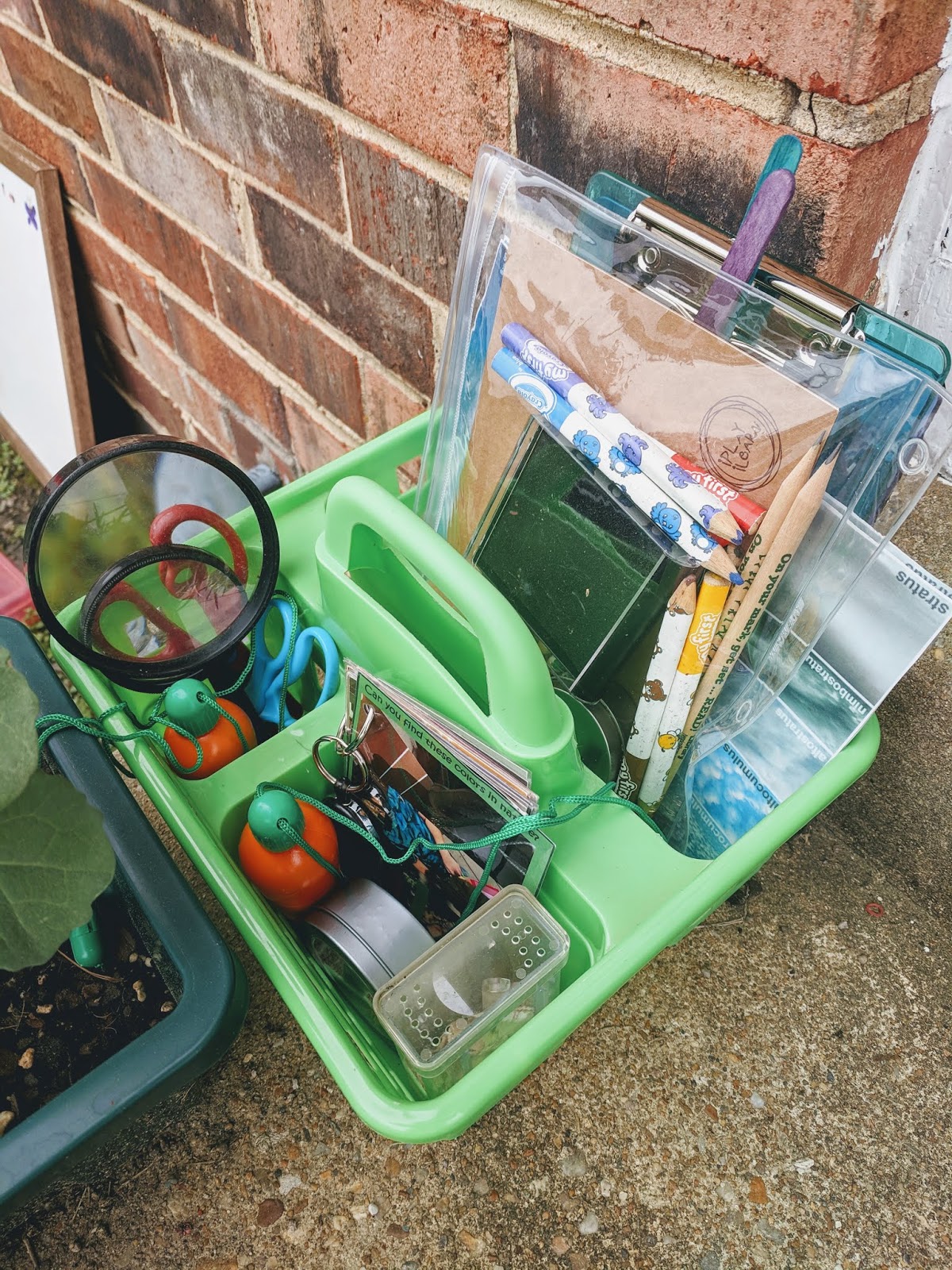
 Tools and materials to encourage taking a closer look, documentation, observation and a little bit of fun and wonder fill these plastic caddies in the front play garden and in the back. For items that need waterproofing, I love plastic pencil pouches (available super inexpensively during the back to school season, which is when I stock up).

Some items you might include are:

Ok, there are definitely some bubble necklaces in there, too--you never know when you might need one of those!

A designated dry erase board or chalk board can make for a wonderful vertical surface with a tin or waterproof pouch or box containing markers or chalk. It's a great place to draw, write garden messages and/or observations. Also a wonderful location for magnetic poetry or pictures if it happens to be magnetic as well.


Caddies or totes intended to encourage exploration of wildlife and taking a closer look outdoors might include some of the following:

  • critter cage or butterfly net
  • magnifying glasses
  • prism lenses
  • prisms
  • binoculars
  • large tweezers
  • bug/butterfly nets
  • small field guides protected in a waterproof pouch or laminated cards/pictures


Elements of Sound:
I live with two little boys for whom everything is a drum. I'd love to have a sound wall outdoors but I also love not being homeless and evicted from my apartment. Our "quiet" xylophone resides outdoors now inviting my youngest musicians to grab a stick or even a spoon or garden tool and tinker out a tune--not too loudly--in our play garden. Aside from that, there is plenty of using our outside voices outside...

And kudos to that neighbor who used to send her daughter outside to practice her recorder last year! You are my hero!

Sometimes the element of sound is observed as we listen to birds chirping, neighborhood sounds, buzzing bees, barking dogs, children playing...


Elements of Touch:

Gardening is a hands-on experience when it comes to digging, sowing seeds, harvesting, pulling weeds... But a lot of the time we find ourselves telling the bodies attached to the smaller hands in our family not to touch the plants, not to pick the flowers, not to step on the grass...

So finding elements that children are encouraged to touch and manipulate is a must! Many plants can withstand a child's touch and furthermore, learning how to touch and move their bodies around plants and flowers and wildlife is an important lesson for children to learn even early on. We've had our share of mishaps---like a watermelon plant removed from its roots, some toppled and trampled mammoth sunflowers and even some prematurely plucked green tomatoes. It's all par for the course. If we cannot fail in the garden, where can we grow?

I really like to find ways to get to YES in world full of NOs. Elements for mixing, concocting and sensory play are abundant outdoors and need very little added. Three of my very favorites are dirt, sand, and water. Having access to those can lead to a plethora of play and learning opportunities.

Succulent plants do quite well to be touched and tickled. They come in a variety of textures (do avoid very sharp cacti with young children) and colors and sizes. Our Please Touch the Plants garden is finally back outdoors and adjusting to its preferred habitat after a winter being cooped up by our dining room windows.


We may not want the children cutting flowers or plucking veggies out of our own garden beds, but having a space or a pot that is their very own can make this activity one that is available to them. Our snipping garden is merely an old window box with small violets, pansies and hostas. I choose inexpensive plants or parts of my own plants to place in the box as needed. Herbs would also be a lovely addition. Sometimes S likes to gather some flowers to put in a small pale or vase of water. Sometimes the boys pluck or cut blossoms for mud and water potions and concoctions. They know that this is their plot for cutting and plucking and that other pots and places require permission first. Cutting the grass is also always a popular activity and identifying weeds with my assistance allows for additional gathering and foraging opportunities.


Elements of Scent: Herbs, herbs, glorious herbs. Long before the flowers are blooming and the fruits and veggies are ready for harvest, starter plants are in abundance at garden nurseries, hardware stores, grocery stores and farmers' markets. Early on children can be shown how to gently rub their hands over the fragrant leaves to release the scent or even how to pluck one or two leaves and rub it between their fingers. A mortar and pestle can introduce a whole new level of grinding and crushing and smelling these fragrant wonders of the kitchen garden...
These are the earliest lessons in the season of harvest to table. Mint leaves come in to be steeped in hot water for tea. Chives are pulled and tasted right from the planter! Rosemary and lemon balm are finely chopped and added to a batch of homemade melt and pour soap to scrub our gardeners' hands clean when we do finally come inside.


Elements of Taste:
One of the greatest reasons to garden and grow things is to eat things that you grow! Year round, microgreens can be quickly and easily grown indoors. Thinning out early seedlings is a lot less emotional for the attached gardener if you can harvest and enjoy the tiny sprouts, like with the beet sprouts pictured to the left.

One of the harder parts of gardening to grow your own food is, well, waiting for it. Having plants that are in various stages of readiness is helpful for me (and the younger gardeners here). Earlier cold weather crops like lettuces, greens, and broccoli help tide us over while we wait for the first harvest of quickly growing crops like radishes that can be planted in rotation throughout the season. Buying starter plants can speed things along once the season has begun (especially if you didn't start seeds indoors). And when it comes to choosing what you'll grow to eat, I'd suggest choosing what you like to eat. Perhaps save the farmers' market for trying something altogether new and avoid that issue of bringing up a crop of hot peppers nobody likes.


I also like for the boys to have some plants that are their very own. Last year, for S this was a beloved strawberry plant that overwintered beautifully and has returned to flowering this spring! We also planted new strawberries with each of the boys as soon as starter plants came out. Nothing is sweeter and more exciting than a big, juicy, red berry plucked fresh from the vine, no sharing!


There is truly a sense of wonder and reverence for something you've grown, nurtured, loved and harvested yourself. This year both of the boys are old enough to participate in this process. They would likely choose every plant in the nursery if it were up to them. S was enamored with a giant horseradish plant last year but alas, I had to quell his thirst for it because we simply didn't have the space. And I also knew he wouldn't eat it! Y was enthralled by every plant and shrub and tree on our recent nursery walk and really wanted a cherry tree for our yard. I sadly did have to decline and settle for some broccoli starters (they are like tiny trees!) because we cannot plant a cherry tree in our apartment yard...

I would also go completely insane purchasing plants if left to my own devices. And maybe then, I'd have so many that no one would notice if half of them are dead!  But the garden when set up as a place that nurtures wonder and curiosity also encourages us to slow down. To breathe in the scent and taste the flavors of the season. To hear the sounds and feel the textures and the breeze. We slowly observe the world around, and above and below...and we cannot help, even as adults, but return to that coveted place of playfulness.

Elements of Playfulness:
Everything I sneak and stash in my garden is to invite my children and myself into a world of play. Tiny fairy gardens, mud kitchens, tools for scientific exploration and discovery, baskets of nature's loose parts, cooking accessories, toy barbecues, ribbons and pinwheels for blowing in the wind and weaving, sticks for stirring, casting magical spells or walking, silk flowers for "planting," real gardening tools for digging, chalk for drawing and rocks painted as bugs, animals, favorite foods, or labeled with letters and words spark a sense of wonder in players of all ages. And, of course, your more "traditional" outdoor toys--for riding, rolling, throwing, catching, driving...

A garden is a space that nurtures wonder and curiosity on a grand scale, but it doesn't need to be a grand space and nor do we need to stock it with large elements for play. Very tiny spaces can be enormously enhanced by small scale additions, stored and tucked away in creative ways to draw in interest. With that in mind, our garden is not a place we visit to escape or even a stop on our way indoors. It is, rather, the destination itself. It is the place we go to reside until we are hauled in under an arm like a football, kicking, screaming, protesting and covered head to toe in mud.

Happy Playing!

Friday, April 12, 2019

Bonus Post: Outdoor Classrooms as an Inclusive and Accessible Space

I recently gave an interview with a fellow nature educator and the incredible mind behind the website Outdoor-Classrooms and over the course of the conversation got on the topic of nature-based classrooms as an inclusive and accessible space. I've put together a three part series here on building your own outdoor classroom, whether at home, in a school setting or even on the go. I've touched upon a variety of reasons I am so passionate about outdoor play--an area of childhood development that I feel has been hijacked by adults at best and completely neglected at worst. Those who know my professional background know that I also have a passion for inclusive and accessible classrooms and learning spaces.

My classroom teaching experience has provided me with a multitude of opportunities to see and facilitate inclusive classrooms in action. Teaching under the traditional inclusion model, I learned that my own personal ideal was not always ideal for the students in my care. I firmly believe that educational opportunities should be readily available to all children regardless of ability and/or disAbility. I also firmly believe that all classrooms function best when everyone in them is able to access these educational opportunities. In some settings, the "inclusion model" was functioning well to serve this purpose most of the time. In others, it was not.

Through these experiences, I also came to reframe my own concept of what inclusion looked like. Whereas my lens had previously been focused on integrating and eliminating visible lines between "typical" models and peers with "special needs," I came to feel strongly that a well functioning classroom community was not necessarily about making these boundaries disappear but rather recognizing the unique needs and the common needs of each individual in their environment. Meanwhile, I also noticed a common trend among all children: a significant decline in play skills. Teaching pro-social behavior through play was no longer something I did for children specifically on an educational plan, it was an area of deficit for nearly all my students.

And this extended to the playground. Whereas just about 5 years beforehand most of my students begged to go outdoors and were immediately and consistently engaged, now my students maybe still begged to go outdoors but were quickly disengaged, engaged only in repetitive play schemas (particularly scripted re-enactments of television shows or movies) or even asking to go inside and complaining of boredom. I attributed this play deficit to a lot of potential factors including (but not limited to) an increase in technology/screens, an increase in helicopter parenting and teaching, an increase in focus on "academics" earlier on and a correlating decrease in open ended toys and child led play opportunities. And when it came to the physical layout of classrooms and outdoor spaces, even the toy aisles in stores--things had changed as well. There were more and more single-function, brightly colored, noisy and battery operated materials that encouraged various developmental skills but not a whole lot of movement.

Areas intended for movement also changed. Outdoor nature spaces as well as indoor gross motor spaces were fit with colorful plastic playground equipment and while I certainly value swings, slides, ladders and monkey bars, they also serve only a limited set of functions. But one thing remained consistently true: given the same amount of time in an indoor gross motor space as an outdoor one, children outdoors eventually engaged in some sort of meaningful play activity whereas indoors, many would literally just run in repetitive circles. And cognitive, social and/or developmental differences that seemed blatantly visible inside of a classroom setting or even an indoor gym were almost invisible outdoors.

Here are a few anecdotal examples:

The Garden of Eatin':
In one of my first years as a lead teacher I taught in an inclusive Pre-K classroom with a high ratio of very aggressive and energetic boys. We had four adults to 12 children and many parts of most days still felt like a battle to merely survive. Indoors we had a divide and conquer mentality. Group times were all about location and proximity to key players. Teaching in a climate with a cold winter meant that we were often indoors for the duration of the day--a whopping 9 hours for some children. We had a gross motor room and even the addition of new (and expensive) play equipment didn't seem to change the amount of spinning, stimming, running in circles and disengagement of most or even all of my students on some occasions. These kids needed to be outside and I, being the teacher who got outside no matter what, was often the one who would gladly take them regardless of the elements. There was a lot of running involved and a lot of space; in related news, I lost 25lbs that year. The kids were all over the place, but they were all engaged in meaningful play activities even if it took a chunk of time (and physical space) for that to begin and looked different from child to child.
A teacher in another classroom had a garden she worked on with her students each year and one day, in the early spring, she invited my class to come work in her garden. I was honestly a little intimidated. This was her brain child and she was truly epic in her time--the hipster of outdoor teaching if ever there was one! The garden space was adequate, but small and I wondered what would happen when I released 12 very active students into this space, some of whom had probably never seen a garden up close before. Not a lot of the other teachers were running to volunteer to join us on our visit, so I entered those gates with my kids in trepidation. And an amazing thing happened out there. It became almost silent. The students were all crouched low, shovels in hands, pulling weeds, discovering worms and roley poleys and lettuce that had overwintered and returned. And you would never have been able to tell for even a moment "who was who." Students on the autism spectrum, students with medical needs, students with backgrounds of trauma and "typical peer models" all looked exactly the same working in the garden.

Line Up: In another classroom, I had a student who had various learning and processing difficulties. In the classroom, he struggled with impulse control particularly in instances when his ideas and emotions would precede his ability to verbalize them. For instance, he might not immediately think to use words to ask a friend to play but rather hit the boy he desired to play with. He thrived with verbal support, a calm environment and time and space to process. He had a strong need for organization and also for large body movement and heavy lifting. Inside, this may have been portrayed by disruptive behaviors at group times when a number on the calendar was upside down. He might struggle with the compulsive desire to move our classroom furniture (sometimes rather aggressively). He struggled within a small indoor space to move his physical body in ways that were not destructive to his peers' play or their physical bodies at times. And in his play, he loved to organize things and line them up.
Indoors, these tendencies stuck out like a sore thumb. Peers often talked about his behaviors or avoided him altogether at times. But outside, something incredible would happen. Every day, this boy would bypass the bikes, bypass the playground structure, bypass the shovels and pales and even the swings and head right for a collection of plastic chairs, tables, push toys, riding toys and other similar sized objects/equipment. He would begin to lift them, move them and line them up. For the longest time, teachers asked him to stop. They gave him other things to play with, had him sit out at times, you name it--anything to stop the repeated process. And one day, I asked why? Why did we need him to stop moving the furniture and equipment? And so one day, I asked the teachers not to disallow it, but rather to observe with me. And we noticed that as he lined up chairs and tables and other items, that other children were also joining in. Sometimes it was a train. Sometimes it was a plane. Sometimes it was a restaurant or an ice cream shop. Sometimes it was a tower or skyscraper. And maybe the intended "purpose" of a chair was not to be a building block, but why, in the safety of enough space and support, could it not be used as such?  Instead of being the kid who other children avoided or asked questions about, he was now the leader of a plethora of outdoor games and activities. His peers sought him and couldn't wait for the day's adventure.

Eye Contact and Nature Contact: In yet another year of teaching, I had a very small class with very close knit families. The students all had pretty long term relationships with one another and their families did as well. Even in this small group, there were unique personalities and learning differences. One student in particular had increasingly visible difficulties with focus, attention and certain social/play skills. As his peers grew to engage in joined schemas of symbolic play, he remained very literal in his play. A block was always a block, never a telephone. As his peers grew to naturally move through routine and repeated classroom and self care tasks, he struggled to remember to get up from his chair and move on to the next activity or how to organize and dress himself in outerwear. He was incredibly bright and soaked up information like a sponge, even if he was staring out the window tracking a ball being thrown back and forth during Circle Time.
Visual tracking is visual tracking, and he was also successful at tracking words on a page earlier on than most peers. He did, however, struggle with making eye contact and given the choice to play and engage with others or independently, always chose to remain alone and watch his peers at play. He would take out a Montessori work mat just like his peers. He would set up a toy, activity or learning material on it, just like his peers. But he would not actually use what was in front of him. A puzzle might remain in the box with the cover on the entire time if no adults intervened with support. Rather, he would watch his peers engaged in their activities. Sometimes, he would scoot closer to them. He never asked to join in an activity and even when prompted, still had no interest in joining. At almost 5 years old, he was still engaging only in parallel play, developmentally typical of children several years younger. More and more his peers noticed and spoke about some of his quirks. He compensated by acting silly or saying "I forgot" but indoors it became increasingly obvious that his focus, attention and gaze were different in many ways from his peers'.
He loved to go outside. In fact, he couldn't wait to get out there every day. Even so, he would always be the last one ready and needed continuous and consistent support to get his outerwear on and line up with his classmates. Many times, he also needed a quiet space to carry out these tasks so as not to be distracted by movement or noise in the classroom. In transit, his eyes were rarely on the space in front of him and he might wander off or bump into someone/something directly in front of him. On the playground, he did somewhat engage in play. He enjoyed climbing and even sometimes copied or mimicked play behaviors of his friends. They continued to invite him into their games and while he couldn't adapt a stick to be a magic wand, he could repeat Batman's line verbatim the first time he heard it. One day, it was rather rainy. Not necessarily a great day for our playground, but a perfect day for what I called a duck waddle. As we filed out of the front door and waddled down the sidewalk, quacking, I heard our little friend call "Stop! I see something!" He'd found a garden snail on the front step that none of the rest of us has even noticed. This little boy who struggled to focus, to tune in (or tune out) and even to make eye contact was the only one in the group who discovered the snail. His peers were enthralled and everyone spent the remainder of the walk honing in on the ground to see what we might discover along the way...

Playing in the field levels the playing field. When children (and adults for that matter) encounter nature, something phenomenal occurs. Our experience outdoors is so unique and so individual that there is an inherent shift of focus from "standards" and "norms" toward commonalities and a shared sense of wonder. Those who indoors might be more active may be more reflective outside. Those who are not as confident in organized athletics might be more confident exploring the boundaries of a rocky terrain or climbing a tree. I, for instance, was a child with low muscle tone who was quite prone to falling and not at all coordinated with a ball, a bat or even a jungle gym. I lacked the confidence to play most sports games and felt intense anxiety over the performance aspects of gym class. In my own backyard, I climbed a Japanese maple tree and stood on a plastic saucer trying to ski down the snow covered hill in the winter. I had little to no risk aversion in my own backyard when I could navigate when and how to try things but intense aversion to climbing any higher than the second rung of the monkey bar ladder on the playground.

Indeed, the children who may be more likely to "follow" indoors often emerge as leaders outdoors. Children with strong language skills, observational skills and interests in science thrive outdoors even while these may be less sought after traits on the basketball court or in the playroom. And when it comes to setting up an outdoor classroom versus an indoor one in a manner that is inclusive and accessible, the work is almost always already done for us by Mother Nature herself. Abundant in loose parts and opportunities for discovery and learning, very little needs to be added to an outdoor space. Physical accessibility is an area of challenge in many buildings and often less so outdoors where spaces are open and surfaces are varied. Additionally, gaps in ability to navigate the variety of terrains and surfaces are a shared experience by all based not just on whether or not a person has a "diagnosed disability," but rather also on age, experience, confidence level, interest, etc. Children can play "differently" and simultaneously and not be "different" in doing so. Everyone is having a novel experience outdoors. Everyone is discovering something for the first time. Everyone is working toward an independent goal and everyone can share in the wonder.
When we look at the benefits to health and well being of all children in open ended outdoor play, it really brings forth the question of why this is something we are limiting and eliminating in our education model. In a tireless effort to knock down walls and barriers, we are building more walls and more barriers. Our spaces for learning and discovery are getting smaller and smaller and smaller. A friend of mine who is very active in the world of advocacy for disAbility awareness and inclusion once said that being inclusive is not about treating everyone the same, but rather about treating everyone differently. It sounds odd, but when you reflect on it for a moment, it makes sense. Our education model and even our current models of inclusion are often about erasing those differences or attempting to make them "less visible." But what if instead of forcing a square peg into a round hole, we allowed a space for both? Outdoor classrooms and natural environments provide a space completely uninhibited by walls (or a roof for that matter). Pace, space and purpose are accessible to all and everyone can engage in happy playing!

Wednesday, March 27, 2019

Creating an Outdoor Classroom, Part 3: Taking It On-the-Go


We've unpacked the idea of creating an outdoor classroom and how to do so if you're short on space and cash, so now let's talk about taking it with you! Whether your outdoor classroom needs to be mobile because you do not have a designated permanent outdoor space or because, like me, you are running a traveling outdoor program, today's post is for you. And even if you do have and utilize a permanent outdoor space, nature based learning often requires materials to be easily transportable--so keep reading. I'm a visual learner, myself, so I will be including some extra photos in today's post to spark some seeds of inspiration as you grow--I mean, go...

You can't take it with you! WRONG! You totally can! And really it just takes a bit of planning and creativity when you want to take your learning outdoors and on the go. There are some key factors to consider as you pack your bags (or bins or baskets).
  • Mobility: how will you haul your stuff from point A to point B? Additionally, how will the members of your group get from point A to point B? Are there children who are not yet mobile independently? If so, is your destination one that is stroller friendly or will you need to carry/wear infants and young toddlers? These are all things to consider as you pack yourself and prep your crew.
  • Your Destination: what is the terrain like where you will be? Will you be able to roll your goods or only carry them? What's already at your location and what do you need to bring from home? Are there public restrooms available? What is parking like? If you're meeting up with a group, have you made your meetup location clear?
  • Weather and Climate Conditions: When you're teaching outdoors, you're at the whim of the elements. Literally. You need to consider wet, muddy, windy, rainy, hot/sunny, cold/snowy/icy conditions in advance as much as possible. What do your children need to wear to be comfortable? What do you need to wear to be comfortable? (Keep in mind, adults are often less mobile outdoors than children, especially if you're stationing yourself at a particular location to lead a lesson or see your group--you might need more layers than the kids do to keep warm!) If there's no shade/shelter from sun, you might consider bringing umbrellas, hats, sunglasses, sunscreen. If it's a windy day, do you have a way to weigh down a tablecloth/blanket or loose sheets of paper/materials that could blow away? If there's potential for wet conditions, can you supply extra towels or plastic ponchos? 
  • Miscellaneous Needs: First aid kits, towels, wipes, a trash bag to collect anything disposable, plastic bags for wet/dirty linens or materials, changes of clothes for you and your family just in case, and snacks/water are all things you might consider having available as you go, whether in your car or in a pack to carry along.

So now that we've run through the nitty-gritty list, here's the fun part: setting up and creating your Nature-on-the-Go Kits! 


  • What is a Nature-on-the-Go Kit?  This is the name I give to any activity or materials I bring with me outdoors, whether large or small. Think of it as an educational picnic of sorts! The idea is that you take what you need with you in a way that makes it easily transportable and accessible once you are at your destination. With a little planning and imagination, your Nature-on-the-Go Kits will be truly delicious!
    I love pencil pouches for smaller Nature on the Go Kits. You can also purchase
    plastic ones very inexpensively, which are more waterproof/weather resistant. You can
    store several of these in a large binder if you need multiples for a larger group.
    Consider keeping a laminated card attached with a metal ring of what is inside each
    pack so you can remember to check that it all gets replaced and brought back
    with you when you leave--especially if you are circulating your packs.
Some Nature-on-the-Go Kits are as simple as a pencil pouch always kept in the car or in your Mom Bag ready for a park visit or playground trip (or even a wait in a restaurant or doctor's office). It may be as simple as a notepad, some colored pencils, some double sided tape for sticking/collecting interesting bits of nature and foliage, maybe an ink pad for pine cone and seed pod prints or a broken unwrapped crayon for tree bark or rock rubbings. Even a tiny pot of clay or playdough can be easily towed or a small magnifying glass for closer observation. Larger kits can include a sketch book or nature journal, field guides and relevant books, binoculars, containers for collecting items found in nature, both living (temporarily--make sure your container for that is appropriately made with air holes) and nonliving (I love small tins with windows or magnifying glass boxes). Some Nature-on-the-Go Kits can even be lesson specific if you are bringing a particular literacy, math, science, art or play based activity outdoors. The main things to consider as you build a Nature-on-the-Go Kit (or even many of them) are:

    • how you will transport them (mobility)
    • what you will need in addition to what you're bringing and what is available at your destination
    • how you will set it up when you are there
    • what you will need in order to clean it up and take it back with you
    • how to store and transport it in a way that protects it from unforeseen weather conditions
I do not recommend bringing along more than you can easily tow. On the other hand, if your kids and/or other adults can help you transport, delegate away! If you have access to water on site, that's one thing you can leave behind--just bring the containers you'll need. If you don't have access to water on site, don't forget it! For ease of mobility and transportation, many natural teachers prefer backpacks for their goods. These are great and you can find them secondhand quite easily. Tote bags, baskets, plastic bins with lids, wagons, rolling suitcases or carts or even a wheelbarrow can be used outdoors to transport materials.

I also think it is worth honorable mention to talk about transporting people--specifically the little people in your crew. My boys have become a little bit addicted to the double stroller when we head out to our nature based playgroup meet-ups and I have gone with it because I like it for the storage capacity. On the other hand, they are both big enough to walk independently and getting too heavy to push up huge hills... In creatively addressing this issue, I might switch my own transport method to using a rolling suitcase or cart or even a backpack and walk alongside my boys. For reluctant walkers, I've even heard of natural teachers using a drum or puppet to help lead the group. Make the journey there part of the fun. Encourage children as they are able to "help" by carrying something or perhaps simply carrying an empty basket to gather natural treasures along the way. And when it comes to those big hills and strollers, some older children might even enjoy the opportunity to help push it up the hill rather than being the weight inside of it that threatens to pull you both back down!

Now let's take a peek at some Nature-on-the-Go Kits and how we've used them:

In addition to considering what you pack and how you get it there, also plan in advance how and where you will station and set up when you do get there. Picnic tables are great if you have access. If not, a large blanket or tablecloth can be spread on the ground. If wind might be an issue, have some heavier items available to weigh down lighter ones or even your tablecloth/blanket. In a real pinch, I've found large rocks to be helpful! Additionally, keeping items not in use in bins with lids can prevent things from blowing away and keep it a bit more organized while you're not actively teaching.

Speaking of bins with lids, I LOVE them for travel sensory play. Here's a file sized bin being used for exploring (and storing) parts of trees...

And here's one being used for a collection of river rocks...

We love our DIY Color Scavenger Hunt Cards--made from laminated paint samples we acquired for free at the hardware store, these are a great way to turn a nature walk into fun color scavenger hunt. You'd be amazed at how many hues and shades of colors can be found outdoors all year round.

Art outdoors can go vertical with the use of tabletop easels. They fold, they're cheap, they're portable and lightweight. 

Even more budget friendly and easily portable are clipboards! These are great to take on the go and offer on site. Just add paper and a writing/drawing utensil...

Nature Journals can be purchased in the form of a notebook or sketch book (even recycled from school supplies that weren't used or fully used) and/or made at home. Our nature based playgroup kicked off our new year creating these simple stick bound nature journals from paper, a stick and a rubber band. I will post instructions in the future (or you can look it up on Pinterest as well, this is a popular activity in book making!). 
These nature looms are easily made from recycled cardboard and rubber bands. They are a simple and beautiful way for little ones (and grown ups, too!) to collect and display items found from nature. In the Autumn, they can hold colorful leaves and seed pods and pine cones. In the Spring, they might collect wildflowers in many colors. Come summer, and they become a fragrant display of cut herbs from your kitchen garden. Even in the winter, sprigs of evergreen trees and berries add a bit of life and greenery to a drearier season of the year.


My playgroup loves meeting up at local sprinkler and water parks in the summer. The best part of a park that is abundant in water supply is not having to haul that with you. Rather, our Nature-on-the-Go kits contain activities that require only the addition of water--such as watercolor art, empty bins with toys for water play (especially great for babies and young toddlers not yet able to use a sprinkler park independently) or even seed planting activities. Just add water!

In an effort to encourage outdoor play in all types of weather, we bring activities that give enjoyment and a splash of color to all types of weather--even windy weather. And the weather conditions on this day did not disappoint! The children (and adults) loved making ribbon kites using colorful strands of ribbon and shower curtain rings. It's so cheap (all dollar store purchases), so simple and yet so much fun.

My list of water play toys is certainly unconventional at best, but it's inexpensive, always popular and easy to replace if some random kid at the sprinkler park really falls in love with your sponge brush and you don't have the heart to grab it back before you leave...not that this has ever happened to me!
Nature-based Literacy on the Go kits are a great way to keep everyone reading when school is out. Why should summer reading restrict you to a couch or chair indoors? Grab a book (or two or three), some puppets or toys, costumes or props for story telling and have a good read together outside. 

  • Starting Up Your Own Nature-Based Play Group: If creating an outdoor classroom with no walls or roof has the same appeal to you as it did to me, you might be ready to start your own meetup group! I will be the first to admit that I am a bit introverted and sometimes even shy. Putting myself out there when I'm out there is not totally within my comfort zone. Nature is my comfort zone, so that definitely increases my confidence a bit, but reaching out in that way--even among friends--is a stretch for me. I love it, nonetheless. We've had activities that were successes, activities that were flops and everything in between. We've had meetups with a huge turn out and one with only one other family--they have all been equally valuable and amazing. My initial vision and what I am actually doing are not in 100% alignment and I've tweaked and changed my vision quite often. I hope it will continue to grow and evolve just as our garden does. 
If starting up your own group sounds like something you'd like to pursue, here are a few things to consider:
  • Who is your target audience? Who are you looking to reach? Your friends and family? A local school? Only children or children with adults? Is your group open to children of all ages or geared toward a specific age range? Will it be by invite/word of mouth or open to the public? In the event it is by invite only, be mindful of your space/location and any potential needs to reserve space in advance.
  • What is your mission? Setting an intention for your group can help shape your approach. Are you looking to socialize? Are you wanting to teach? Are you aiming to inspire others to get outside more often? Your mission and intentions may change and evolve often and that is OK--it's a great idea to assess your program as you build and run it and to address areas in which it might grow or change. It is also important to make sure that your mission is a reflection of your own values as well as the interests and values of your group.
  • Where will you meet? I utilize public locations like parks, playgrounds and even nature spaces behind local libraries. Will your group always meet in the same place? Or will you park hop like we do? Will you be meeting in locations that require payment (like private gardens or botanical garden centers, museums or U-pick farms) and if so, how will you handle this? 
  • Cost and Money Matters: I feel strongly about the outdoors being accessible to all and that includes financial accessibility. I choose not to meet up in places with a cover charge and I also choose not to implement a cover charge for my events. As such, I use what I have on hand for activities or when we do need supplies, I ask for families who wish to and are able to contribute (such as seeds for a seed exchange). Delegating leadership in your group can also help divide some of the costs. Someone who has a lot of experience with rock painting might have all the supplies on hand at home and be happy to lead the activity. Because parks and playgrounds are free and open to the public, they are the perfect "outdoor classroom" for taking the show on the road. Also consider inquiring in public schools that are off during the summer (and might even love the help with their own garden maintenance), community gardens, farmers' markets, local farms and nature spaces at other public venues like libraries and museums (many museums have outdoor spaces that are accessible and open to the public even if their indoor exhibits cost money).
  • Accessibility in General: Nature is a space that can and should be accessible to all. When I plan my events, I try to keep in mind families who may need accommodations for any number of reasons. Some of the things I've had to think about for my own family and/or others are:
    •  allergy and food safety (this includes strictly kosher diets and extreme food allergies/allergies to certain seeds and plants as well as animals)
    • mobility challenges for infants/toddlers or other reasons--is your location stroller/wheelchair accessible
    • sensory differences and meeting in spaces where there is support for families with children who may struggle with related issues
    • concerns of elopement or children who frequently run off--is your location securely gated and if not, can you work with other adults to ensure safety and a set of eyes in a variety of locations
    • activities that are accessible to all ages and stages--this means I include a blanket with floor activities for younger ones and engaging activities for older children and even adults
    • awareness and sensitivity to those who may need service animals--this is an issue I have had crop up in my groups whether it's a group member or just a visitor at a park. As a group leader, I absolutely allow and support those using service dogs to attend and I also explain and expose my children to their purpose. My older son is quite fearful of dogs, so it has been a process to be in parks in general, but this is a great opportunity for exposure in a sensitive environment.
    • childhood fears and anxieties (and adult ones, too!) We've made it through the intense fear of public toilets flushing and hand dryers here so we can finally go back to that one park... But in all seriousness, there are fears and anxieties that crop up outdoors and everyone has different comfort levels. Children and their adults have different comfort levels with getting dirty, playing with sticks, being exposed to the elements, and proximity to one another while we're out there. I never push. I offer. I expose. I don't force. 
  • When in doubt, ask! Overall, when it comes to meeting group needs and making it accessible to all, I just ask. If you're not sure what a child with multiple allergies can safely be around, ask! If you're not sure a member traveling with a service animal feels welcomed and included, ask what you can do to assist? If a group member is uncomfortable with something or concerned, ask! I've yet to offend someone by asking (at least I think) but I'm sure there are occasions in my life where I did offend someone by assuming.
  • Frequency of Meetups and Leadership: Will you meet on a regular basis or schedule (like I do) more sporadically? How will you advertise? Social media? Word of mouth? Phone/invitation? Will your meetups be weather dependent (mine are) or will you go outside no matter what (#lifegoals) and risk the old no one shows up thing? Will you tend to all the leadership duties on your own or delegate roles to others? You might even consider a more co-op style meetup and rotate leadership and location that way...
  • What will your teaching style be? I initially envisioned giving a formal group discussion with parents on topics of outdoor play and learning and directing activities with the kids. I chickened out after the first group. Turns out, I still don't like talking to grown ups in a formal way. I also didn't feel I could focus on direct instruction in this way while also being present with the children (particularly my own) in an open, outdoor space. What I do like and find that works for me and for my diverse group of families and children of all ages is having the activity open and set out and being intermittently available to my own kids, others' kids and to the other adults to talk about nature based topics as they crop up or any topic at all for that matter. My own kids often are more excited to play with other kids than to do the activity (which many times, they've already done at home). Sometimes an activity goes untouched and that's OK. Sometimes one is so popular I store it in the vault for a repeat session! I've also infiltrated less "direct" ways of teaching as well. I now tow along a "Little Traveling Nature Library" that includes books for all ages and some hands-on materials and resources associated with our activity theme. This is a great way to bring literacy, science and other learning areas on the go with you. I also provide access to information I think is interesting and relevant on my group's Facebook page. I've thought about doing more age-targeted groups in the future, outdoor story times, themed master classes, etc. It's OK for your goals to be more in the long term--a garden grows at its own pace!
I hope this series has been a helpful one as you plan or revisit the use of your own outdoor space and nature based learning. I'll continue to post on our nature based activities in our "Get Outside And..." series and surely we will be sharing our own garden journey this season. You might be a seasoned outdoor teacher already. You might be in the stages of just sowing the seeds. Or perhaps you're not even there yet and you're just perusing those proverbial seed catalogs and dreaming up your future garden. Whatever stage you're at, I encourage you to step outside. Inspiration will follow and the rest really will fall into place. Until then....
Happy Playing!